Showing posts with label Michael Dubruiel. Show all posts

Wednesday, July 1

July: The Precious Blood of Jesus


 The National Eucharistic Pilgrimage is reaching is climax July 2-5 in Philadelphia. Resources on the Eucharist for children:

  On the Catholic calendar, the month of July is dedicated to the Precious Blood of Jesus.

A related entry in the Loyola Kids Book of Catholic Signs and Symbols by Amy Welborn  is the entry on "Wine." 

For centuries people learned about the Christian faith through paintings, sculptures, objects, and gestures. Simple images still convey deep messages if we learn how to see and understand them. Award-winning children's author Amy Welborn has created a friendly and fascinating sourcebook on the signs and symbols of the Catholic faith. The exquisite illustrations throughout will inspire conversation and prayerful reflection for readers of all ages. Each image appears with a brief, child-friendly explanation coupled with a more detailed description on the opposite page.

From the sign of the fish to the Stations of the Cross, from the palm branch to Our Lady of Guadalupe, Loyola Kids Book of Catholic Signs and Symbols will enable children and adults to experience faith with curiosity and wonder.​


amy welborn


amy welborn


Tuesday, June 30

An Answer from Limbo by Brian Moore

  "amy welborn"

An Answer from Limbo is a 1962 novel by Brian Moore.

Previous posts on Moore’s novels:

On Catholics

Cold Heaven

Black Robe

I’ve read more than that, but those are the titles I’ve written about.

I talked about Catholics on the podcast our first year.

By the way, I saw a recent exchange on Catholics – either the movie or the book, I don’t remember – in which a Catholic traditionalist went into it with high hopes based on the premise and on what he’d heard about the plot, but came away a little mad and feeling betrayed because the novel ends in an ambiguous place in which the “good guy” stubborn traditionalist abbot bravely standing up to (aptly satirized) Conciliar changes turns out to be a more complicated figure, spiritually, than we first believe.

But it’s Brian Moore, so really, you can’t expect anything else. It’s what makes the short novel (very short, really a novella, available on Internet Archive) actually thought-provoking, rather than just flattering to one side or another.

Well, anyway. You know the story: I needed something to read, it was night, no library trip possible, so let’s find something to read on the tablet. I mean, I know, but I never said I don’t read books on the tablet. Much of the time, since publishers put books out of print as soon as a run sells (retaining those rights, of course) – and libraries love to pulp real books in order to make room for computers, if you want to read something published before 1980, you don’t want to buy it, well then, it’s your only choice.

So, I’ve read what’s generally considered the best Moore, but thought, what haven’t I read? Whatever it is, it’s Moore, so it’s going to be short, and that’s what I was looking for.

An Answer from Limbo popped up, I read it over the course of two nights, and, yes kind of short, but mostly: dark.

Especially if you’re, as we say these days, a creative.

What are you willing to sacrifice to get that book published, that gig, to get that post to go viral?

Published in 1962, it reflects Moore’s time in New York City during that period. I don’t know how much of Moore’s life it reflects beyond the expat Irish writer protagonist living in New York – I hope not much. Really. I very much hope nothing at all, in fact!

Brendan Tierney emigrated from Ireland about 8 years previous to the events of the novel. He’s married to an American, Jane, and they have two children. Brendan works for a literary magazine, has had stories published and has been working on a novel (haven’t we all) for a couple of years. He gets a hint that his novel might have possibility, and then, after a publishers reads the first couple of chapters, clear encouragement.

He decides to take the risk and put everything into finishing it. That means quitting his job, insisting his wife go back to work as a commercial artist (she doesn’t mind, she hates staying at home with the kids), and since they can’t afford to hire child care – he brings his widowed mother, Eileen, over from Ireland, to live with them and help out.

It does not go well. 


MORE

Monday, June 29

June 29 - Sts. Peter and Paul

      The Feast of Sts. Peter and Paul is June 29.  Introduce your children to more saints....


amy welborn


The Loyola Kids Book of Heroes by Amy Welborn

 More saints' lives, organized according to the virtues they expressed through their lives.

I. Faith
  1. Introduction: Jesus is Born
  2. John the Baptist: A Hero Prepares the Way
  3. Early Christian Martyrs: Heroes are Faithful Friends
  4. Medieval Mystery Plays: Heroes Make the Bible Come to Life
  5. St. Albert the Great: Heroes Study God’s Creation
  6. Sister Blandina Segale: Heroes Work in Faith
II. Hope
  1. Introduction: Jesus Teaches
  2. Pentecost: Heroes on Fire with Hope
  3. Paul: A Hero Changes and Finds Hope
  4. St. Patrick and St. Columba: Heroes Bring Hope into Darkness
  5. St. Jane de Chantal: Heroes Hope through Loss
  6. St. Mary Faustina Kowalska: A Hero Finds Hope in Mercy
Charity
  1. Introduction: Jesus Works Miracles
  2. Peter and John: Heroes are Known by their Love
  3. St. Genevieve: A City is Saved by a Hero’s Charity
  4. St. Meinrad and St. Edmund Campion: Heroes love their Enemies
  5. Venerable Pierre Toussaint: A Hero Lives a Life of Charity
  6. Rose Hawthorne Lathrop: A Hero Cares for Those Who Need it Most
  7. Blessed Teresa of Calcutta: A Hero Lives Charity with the Dying
Temperance
  1. Introduction: Jesus Strikes a Balance
  2. Peter and Cornelius: Heroes Love Their Neighbors
  3. Charlemagne and Alcuin: Heroes Use their Talents for Good
  4. St. Francis: A Hero Appreciates Creation
  5. Venerable Matt Talbot: Heroes Can Let Go
  6. Blessed Pier Giorgio Frassati: A Hero Enjoys the Gift of Life
Prudence
  1. Introduction: Jesus Gives Us Leaders to Help us Make Good Choices
  2. Paul and Barnabas at Lystra: Heroes See the Good in All Things
  3. St. Jean de Brebeuf: A Hero Respects Others
  4. Catherine Doherty and Jean Vanier: Heroes Bring New Ideas
  5. Venerable Solanus Casey: A Hero Accepts His Life
  6. Blessed John XXIII: A Hero Finds a New WayThe Feast of Sts. Peter and Paul is June 29.  

Sunday, June 28

June 28 - St. Irenaeus


June 28 is the memorial of St. Irenaeus. Pope Benedict XVI gave a General Audience talk on him that is available here. Amy Welborn wrote a study guide for all of these talks of Pope Benedict, and it is available as a free download here. Sample pages are below. 


For Irenaeus, Church and Spirit were inseparable: "This faith", we read again in the third book of Adversus Haereses, "which, having been received from the Church, we do preserve, and which always, by the Spirit of God, renewing its youth as if it were some precious deposit in an excellent vessel, causes the vessel itself containing it to renew its youth also.... For where the Church is, there is the Spirit of God; and where the Spirit of God is, there is the Church and every kind of grace" (3, 24, 1). As can be seen, Irenaeus did not stop at defining the concept of Tradition. His tradition, uninterrupted Tradition, is not traditionalism, because this Tradition is always enlivened from within by the Holy Spirit, who makes it live anew, causes it to be interpreted and understood in the vitality of the Church. Adhering to her teaching, the Church should transmit the faith in such a way that it must be what it appears, that is, "public", "one", "pneumatic", "spiritual". Starting with each one of these characteristics, a fruitful discernment can be made of the authentic transmission of the faith in the today of the Church. More generally, in Irenaeus' teaching, the dignity of man, body and soul, is firmly anchored in divine creation, in the image of Christ and in the Spirit's permanent work of sanctification. This doctrine is like a "high road" in order to discern together with all people of good will the object and boundaries of the dialogue of values, and to give an ever new impetus to the Church's missionary action, to the force of the truth which is the source of all true values in the world.


"amy welborn"

"amy welborn"


Saturday, June 27

The Wedding People by Alison Espach

    A review by Amy Welborn

The Wedding People by Alison Espach

Along with Early Sobrieties and The English Experience, this is probably going to be one of my top reads of the summer. It's such a good book.

Plot:

Phoebe is in her early 40's. Her husband has left her for a colleague, a colleague who has a baby, and Phoebe has, after years of trying and fertility treatments, not been able to have that: a baby. She's also an adjunct professor of English literature whose specialty is the Victorian marriage novel, but who has, after ten years of work, not managed to finish writing a book.

So Phoebe arrives at an inn in Newport, RI, having never seen the ocean (she's from St. Louis), with a goal: in this most beautiful place, a "happy place" of her imagination, she's going to commit suicide.

In her way: the wedding people.

For this inn has been completely booked for a week-long wedding celebration. Completely booked, that is, but for the one room - a penthouse suite, no less - that is open, at $800/night, for Phoebe's intended one-night stay.

It's not spoiling much to tell you that no, Phoebe does not succeed in her goal, and ends up staying the entire week, her stay paid for by Lila, the bride-to-be, who immediately and almost inexplicably befriends Phoebe after an elevator mishap. Perhaps she senses a connection, perhaps she's relieved to have someone to talk (and talk and talk) to who's not in the wedding party, and perhaps she's also determined that this Phoebe person Will.Not. Ruin. Her. Wedding.

But Lila talks without end, without clear transitions from topic to topic, assuming that Phoebe, a total stranger who has already announced multiple times that se wants to die, is interested in hearing every detail about her personal life. Phoebe can't tell if it's the most appalling or most impressive display she's ever witnessed.

...

And so it goes, a sly reworking of the Marriage Plot, surprises, accidental (or not) encounters, repressed feelings, unexpected connections, feeling trapped and finding release from that trap and all. The writing is just so sharp and knowing and it's very, very funny.

At its heart, it's an unexpectedly moving novel about discovering that your life does matter a great deal in ways you might not even know. Whether you live or die? Whether you continue to live in the story or not? What part you play in it? Yeah, it matters. And how do you discover that? Through opening up and moving beyond your own bubble and even your own very real pain to listen and connect with the pain of others, and, most importantly extending compassion towards those others - and perhaps asking on the way - why can't I extend this compassion and grace to myself, as well?

Lila, every day this week, you gave me a reason to get up in the morning, to put on a beautiful dress and be part of something, and for that I will always be grateful.

Friday, June 26

The Great Adventure Kids Catholic Bible Chronicles by Amy Welborn

        A collection of Bible stories to excite young readers about the great adventure God has in store for those who follow him.


The Great Adventure Kids Catholic Bible Chronicles by Amy Welborn is designed to help children ages 8-12 understand the greatest story of all time. It features 70 stories carefully chosen to capture the story of salvation history in its entirety from Adam and Eve to Christ and the Apostles.


Written by a gifted children’s storyteller, the Catholic Bible Chronicles makes the stories of Biblical heroes like Abraham, Moses, David, and the Blessed Virgin Mary come alive. Each story features an illustration that helps readers imagine what it would have been like to be present as biblical history unfolded. 


This 320-page book reads like a novel and incorporates the 12 color-coded time periods of The Bible TimelineⓇlearning system throughout to make it easier for children to grasp the chapters of Biblical history.


With a focus on how the stories of God’s family members intersect across time, Catholic Bible Chronicles will allow young people to see for themselves that God has a plan for us all.

Thursday, June 25

Diary of a Country Priest by Georges Bernanos

     -by Amy Welborn


"diary of a country priest"

 Note:This piece is one of a series on great Catholic fiction writers that I penned for Ligourian Magazine several years ago. My word count limit was - get this - 540 words. Unbelievable. Well, it was good money for the number of words,I'll say that. So if you're annoyed by the brevity of this piece, at least you know why it's so short now. Of course, there is much more to say on this book, as well as the very interesting life of Bernanos himself.


In the late 19th and early 20th century a philosophical perspective called positivism ruled the intellectual climate in France. Positivists like Emile Durkheim and Auguste Comte claimed that all one can know about human life is what can be observed and that the laws of behavior and society discerned from these observations should be used to organize human life.
Into this scientifically-based and utterly materialistic mileu stepped, one by one over the decades before and just after the First World War, a group of writers who formed what we now call the French Catholic Literary Revival. Francois Mauriac, Charles Peguy, Julien Green and Leon Bloy rejected positivism and reclaimed a vision of human beings essentially defined, not by scientific law, but rather by our relation to God and struggle with evil. One of the finest writers of this group was George Bernanos, author of Diary of a Country Priest.

Diary of a Country Priest, first published in 1936, is just what the title suggests: the fictional journal of a young curate in rural France. The premise may seem simple, but in Bernanos’ hands it emerges as a rich work in which the reader encounters the injustices of French society, the emptiness of an intellectual system that rejects God, the failure of the Church to fully embody Christ’s love for the poor, and above all, the power of a life dedicated to God.

The young priest whose life absorbs us in this novel has come from a background of poverty through seminary into this, his first parish experience, to which he is utterly dedicated. Besides conducting his sacramental duties, he commits himself to visit every family in his parish. He teaches catechism classes and attempts to organize a club for young men. He visits the sick, buries the dead, lives at a substistence level and is bedeviled by a serious illness that is ultimately diagnosed as stomach cancer, but not before it is mistaken for alchoholism by gossipy villagers.

Aside from these daily ministrations and struggles, Bernanos offers us his view of French church and society through the conversations the priest has with a variety of people, ranging from the atheist physician Delbende, the troubled child Seraphita who spreads rumors about the young priest at every opportunity, the more relaxed older priest de Torcy and most powerfully the deeply wounded local countess, who harbors bitter anger at God for death of her son.

What makes Diary of a Country Priest a novel that is read just as much for its spiritual value as well as its literary quality lies in the complex, realistic life of faith Bernanos constructs for his main character, a faith which stumbles in darkness at times, but is on the whole fervent, selfless and Christlike, even in the hostile reactions it sometimes evokes.


The final touch that heightens the personal drama in the priest’s soul is that he believes himself, if not a total failure, at the very least a terribly poor instrument of God’s grace. But what the reader discerns through the unaffected words is that even as he cannot see it himself, the effect of his witness and suffering on others is profound and powerfully embodies the words he speaks on his own deathbed: “Grace is everywhere…”  - Amy Welborn

Wednesday, June 24

June 24 - Feast of the Nativity of St. John the Baptist


Today is the feast of the Nativity of St. John the Baptist. 

Here's the recounting of the beginning of John's life from the Loyola Kid Book of Bible Stories by Amy Welborn. 

Remember how the book is organized. The stories are grouped according to how one would generally hear them proclaimed in the context of the liturgy. Generally. The stories are retold, with a couple of reflection questions at the end. Forgive the poor scan of the second (which is the last) page. I think you can make it out.

One of the aspects of John's origin story that has always struck me is the fact that his father received the news of his conception and name while he was doing something very specific: his duty. Moreover, this obligation, was related to the liturgy. He had a role assisting in Temple worship, a context that was not a free-for-all of doing-what-the-Spirit-leads, but structured and considered a "given."

Couple that experience with how Mary received her comparable news: in obscurity, in a backwater of the Roman Empire, given to a very ordinary young woman just living her ordinary life.

Yes, consider the two together and what do you hear: God meets us in the midst of ordinary life, as we are fulfilling our duties and offering our prayers and worship. Those things are not obstacles to authenticity, they're not barriers to deep, "Spirit-filled" lives.

They are the way. 

amy welborn


Monday, June 22

Amy Welborn on David Lodge

    Amy Welborn on the late novelist David Lodge:

"David Lodge"


Lodge’s two novels offer more than a helpful historical record. They offer a way of seeing the human beings who lived it, a way of seeing that is paradoxically sharp, yet at its heart, quite generous.

Lodge, as his own words make clear, ended up with more “progressive” notions of Catholicism. But because he is ultimately sympathetic to all of his characters and honestly explores their behavior and motivations, the reader never loses sight of the yearning at the heart of every person’s spiritual journey.

David Lodge treated the oddballs and searching denizens of his fictional Catholic worlds with humor, honesty and an attempt, at least, at understanding. Perhaps his work can encourage us, in our very real Catholic world, to do the same.

Sunday, June 21

Amy Welborn Book Review

    Amy Welborn on the mid-century novel The Feast by Margaret Kennedy:


"amy welborn"


The germ of The Feast lies in a conversation Kennedy had in 1937 with writer friends. The group played with the notion of writing a collection, each focusing on one of the seven deadly sins. That specific project never moved beyond the stage of an idea, but Kennedy continued to mull it over until in those post-war years, she found her angle. The Feast is an illustrative sketch of postwar England, a clever theological puzzle, and a suggestive invitation in its own right.


It’s an invitation to the reader to imagine the collection of characters squabbling under the looming cliff, imagine their virtues and vices, and then consider her place there. For in a sense, we are all dwelling under a sort of cliff, one that is bound to collapse at some unknown, surprising moment. We are all invited, as well—invited to the life-saving and life-giving feast hosted by the One the world holds in the least regard. Do we accept? Or do we remain in the inn, as one character thinks as she makes her way up the cliffside to the feast—All alone. All shut up alone in their rooms, yet none of them at peace.

Saturday, June 20

Amy Welborn in Italy

  Amy Welborn in Herculaneum and Oplontis, 2023


"amy welborn"


Always on my mind when I consider the past, but even more so when visiting places like Herculaneum and Oplontis.

Why not Pompeii? We went in 2012, and granted, that was a while ago – there’s just a lot more on this trip I wanted to see that taking at least half a day at Pompeii would make difficult.

Briefly: Took the train from the Naples central station – the Circumvesuvian that goes all the way to Sorrento. It’s often very crowded and a prime pickpocketing location, but this was in the morning in the middle of the week in February, so it wasn’t a problem.

The Herculaneum (Ercolano) ruins are just a short walk from the train station, after maybe a 25-minute ride


More. 

Friday, June 19

Summer Reading for Catholic Kids

"amy welborn"


Be Saints! by Amy Welborn was published by Ignatius Press

Pope Benedict tells children that if we grow in our friendship with God then we will find true happiness and become saints. In this beautifully illustrated book, popular author Amy Welborn introduces Pope Benedict's simple yet profound message to children, given during talks to children his recent visit to England.

In this very colorful book by acclaimed artist Ann Englehart, the Pope's words come to life as he interacts with the children, showing all children how only God can satisfy the deepest needs of our hearts.

Interspersed are prayers and quotes from various saints including Saint Francis, Saint Ignatius, Mother Teresa, St. Paul, St. Peter and more. They all emphasize that the most important thing we can become in this life is a Saint, a true friend of Jesus.


Thursday, June 18

High School Summer Reading List

       This series of apologetics works for Catholic teens and young adults encompasses the diverse questions Catholic teens have in their own hearts about faith, and those they are asked by others.


Prove It: God by Amy Welborn

 I Don't Believe in God Because....

  • ...No One Can Prove He Exists
  • ...Science Shows That the Universe Exists Without a God
  • ...People Could Have Just Made the Stuff in the Bible up
  • ...It’s So Difficult to Find Him
  • ...People Have So Many Different Ideas About Him
  • ...There are So Many Hypocrites in Churches
  • ...People Do Such Horrible Things in the Name of Religion
  • ...It’s What I Believe and I Don’t Need Anyone Else to Tell Me What to Believe!
  • ...I Want to Be Free to Be Myself
  • ...I Don’t Need Him
  • ...Innocent People Suffer


"amy welborn"


Wednesday, June 17

Summer Reading for Catholic Kids


        The Loyola Kids Book of Heroes  Amy Welborn


    amy welborn


     More saints' lives, organized according to the virtues they expressed through their lives.

    I. Faith
    1. Introduction: Jesus is Born
    2. John the Baptist: A Hero Prepares the Way
    3. Early Christian Martyrs: Heroes are Faithful Friends
    4. Medieval Mystery Plays: Heroes Make the Bible Come to Life
    5. St. Albert the Great: Heroes Study God’s Creation
    6. Sister Blandina Segale: Heroes Work in Faith
    II. Hope
    1. Introduction: Jesus Teaches
    2. Pentecost: Heroes on Fire with Hope
    3. Paul: A Hero Changes and Finds Hope
    4. St. Patrick and St. Columba: Heroes Bring Hope into Darkness
    5. St. Jane de Chantal: Heroes Hope through Loss
    6. St. Mary Faustina Kowalska: A Hero Finds Hope in Mercy
    Charity
    1. Introduction: Jesus Works Miracles
    2. Peter and John: Heroes are Known by their Love
    3. St. Genevieve: A City is Saved by a Hero’s Charity
    4. St. Meinrad and St. Edmund Campion: Heroes love their Enemies
    5. Venerable Pierre Toussaint: A Hero Lives a Life of Charity
    6. Rose Hawthorne Lathrop: A Hero Cares for Those Who Need it Most
    7. Blessed Teresa of Calcutta: A Hero Lives Charity with the Dying
    Temperance
    1. Introduction: Jesus Strikes a Balance
    2. Peter and Cornelius: Heroes Love Their Neighbors
    3. Charlemagne and Alcuin: Heroes Use their Talents for Good
    4. St. Francis: A Hero Appreciates Creation
    5. Venerable Matt Talbot: Heroes Can Let Go
    6. Blessed Pier Giorgio Frassati: A Hero Enjoys the Gift of Life
    Prudence
    1. Introduction: Jesus Gives Us Leaders to Help us Make Good Choices
    2. Paul and Barnabas at Lystra: Heroes See the Good in All Things
    3. St. Jean de Brebeuf: A Hero Respects Others
    4. Catherine Doherty and Jean Vanier: Heroes Bring New Ideas
    5. Venerable Solanus Casey: A Hero Accepts His Life
    6. Blessed John XXIII: A Hero Finds a New Way

Tuesday, June 16

Amy Welborn Substack

   Amy Welborn has has a Substack publication, focused on the changes in the Church after the Second Vatican Council. 


"amy welborn"


Confession and penance


So…my experiences? Barely remembered, so sorry about that.

I have no recollection of my First Confession or any confession before high school. Did I go? Was I taken? Probably, but not very often, despite my mother’s faithfulness (complicated, but real).  My only useful memory for this matter is related to the changes in 1976 – the change in the rite itself

and then the change to face-to-face confession.

Filmstrips. During Mass. That’s what I remember. Three Sundays in row at the parish, being shown filmstrips about the new rite. … I think that might have been one of the things that finally drove my mother to stay home on Sundays, leaving me to drive to Mass by myself…..


MORE

Monday, June 15

Ordinary Time for Kids


From The Loyola Kids book of Bible Stories by Amy Welborn arranged with the stories in line with where we hear them in the liturgy - most of the time.

"amy welborn"


Written by popular Catholic children's author Amy Welborn, this beautifully illustrated collection of warm and engaging Bible stories for children and their families is arranged in a uniquely Catholic way—based on the liturgical year and the order in which they are proclaimed during Mass. Divided into five sections—Advent, Christmas, Ordinary Time, Lent, and Easter—each section is subdivided into Old and New Testament stories.
From the Creation to St. Paul, the charming illustrations in Loyola Kids Book of Bible Stories and Welborn’s friendly writing style turn reading the Bible into an experience that draws families closer together and deeper into the heart of the Church.

Saturday, June 13

St. Anthony of Padua for Kids

     June 13 is the feastday of St. Anthony of Padua.  Here is an excerpt about him from The Loyola Kids Book of Saints by Amy Welborn.


Then one day something happened that was almost as strange as the ship wandering off course. There was a large meeting of Franciscans and Dominicans, but oddly enough, the plans for who would give the sermon at the meeting fell through. There were plenty of fine preachers present, but none of them were prepared.
Those in charge of the meeting went down the line of friars. “Would you care to give the sermon, Brother? No? What about you, Father? No? Well, what about you, Fr. Anthony—is that your name?”
Slowly, Anthony rose, and just as slowly, he began to speak. The other friars sat up to listen. There was something very special about Anthony. He didn't use complicated language, but his holiness and love for God shone through his words. He was one of the best preachers they had ever heard!
From that point on, Anthony's quiet life in the hospital kitchen was over. For the rest of his life, he traveled around Italy and France, preaching sermons in churches and town squares to people who came from miles around.
His listeners heard Anthony speak about how important it is for us to live every day in God's presence. As a result of his words, hundreds of people changed their lives and bad habits, bringing Jesus back into their hearts.


The Loyola Kids' Book of Saints by Amy Welborn

"amy welborn"


 Over 40 saints' lives,written at a middle-school reading level.

I. Saints are People Who Love Children St. Nicholas,St. John Bosco, St. Elizabeth Ann Seton, Blessed Gianna Beretta Molla
  Saints Are People Who Love Their Families St. Monica,St. Cyril and St. Methodius, St. Therese of Lisieux,Blessed Frederic Ozanam,

Saints Are People Who Surprise OthersSt. Simeon Stylites,St. Celestine V,St. Joan of Arc,St. Catherine of Siena

Saints Are People Who Create St. Hildegard of Bingen,Blessed Fra Angelico,St. John of the Cross,Blessed Miguel Pro

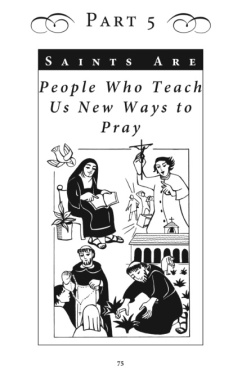
Saints Are People Who Teach Us New Ways to Pray St. Benedict,St. Dominic de Guzman,St. Teresa of Avila,St. Louis de Monfort

Saints Are People Who See Beyond the Everyday St. Juan Diego, St. Frances of Rome, St. Bernadette Soubirous, Blessed Padre Pio

Saints Are People Who Travel From Home St. Boniface, St. Peter Claver, St. Francis Xavier, St. Francis Solano, St. Francis Xavier Cabrini

Saints Are People Who Are Strong Leaders St. Helena, St. Leo the Great, St. Wenceslaus, St. John Neumann

Saints Are People Who Tell The Truth St. Polycarp, St. Thomas Becket, St. Thomas More, Blessed Titus Brandsma

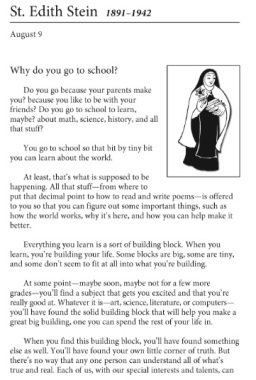
Saints Are People Who Help Us Understand God St. Augustine of Hippo, St. Jerome, St. Patrick, St. Thomas Aquinas, St. Edith Stein

Saints Are People Who Change Their Lives for God St. Ambrose, St. Gregory the Great, St. Francis of Assisi, St. Ignatius of Loyola, St. Camillus de Lellis, St. Katharine Drexel

Saints Are People Who Are Brave St. Perpetua and St. Felicity, St. George, St. Margaret Clitherow, St. Isaac Jogues, The Carmelite Nuns of Compiegne, St. Maximilian Kolbe

Saints Are People Who Help the Poor and Sick St. Elizabeth of Hungary, St. Vincent de Paul, St. Martin de Porres, Blessed Joseph de Veuster

Saints Are People Who Help In Ordinary Ways St. Christopher, St. Blaise, St. Anthony of Padua, St. Bernard of Montjoux

Saints Are People Who Come From All Over the World Blessed Kateri Tekakwitha, St. Paul Miki, Blessed Peter To Rot, Blessed Maria Clementine Anuarite Nengapeta

Friday, June 12

Free Book on Mary Magdalene

     Mary Magdalne: Truth Legends and Lies is available free today


Mary — like Peter, Andrew, and the other apostles — walked away from life as she knew it, abandoned everything to follow Jesus. Why?


“. . . from whom seven demons had gone out.”


Exorcism is an aspect of Jesus’ ministry that many of us either forget about or ignore, but the Gospels make clear how important it is: Mark, in fact, describes an exorcism as Jesus’ first mighty deed, in the midst of his preaching (1:25). Some modern com-mentators might declare that what the ancients referred to as pos-session was nothing more than mental illness, but there is really no reason to assume that is true. The “demons,” or unclean or evil spirits, we see mentioned sixty-three times in the Gospels were understood as forces that indeed possessed people, inhabiting them, bringing on what we would describe as mental problems, emotional disturbances, and even physical illness. The symptoms, however, were, to the ancient mind, only that: symptoms. The deeper problem was the alienation from the rest of the human family and from God produced by this mysterious force of evil.


In the world in which Jesus lived, seven was a number that symbolized completion, from the seven days of creation (Genesis 1:1-2:3) to the seven seals on God’s book in Revelation (5:1) and the seven horns and eyes of the Lamb in the same vision (5:6). Mary’s possession by seven demons (also explicitly mentioned in Mark 16:9) indicates to us that her possession was serious and overwhelming — total, in fact. She was wholly in the grip of these evil spirits, and Jesus freed her — totally.


So of course, she left everything and followed him.


MORE


"amy welborn"

Thursday, June 11

St. Barnabas - June 11

   Consequently, it is not the fact that we have never erred but our capacity for reconciliation and forgiveness which makes us saints”

Back in the day, Pope Benedict used his General Audience talks to teach us about various figures in church history, beginning with the apostles. At the time, Catholic publishers gathered these talks into bound volumes. When OSV did this, they asked me to do a couple of study guides.

This particular book isn’t in print any more, but of course, all the talks are available for free online.

amy-welborn

I maintain that these talks on both the Apostles and the Latin and Greek Fathers would be great parish adult religious education resources – if you agree, feel free to download and reprint the study guide.

Below are the two pages from the guide with suggested study and reflection questions for the unit that includes the talk on St. Barnabas.

The study guide on The Fathers by Amy Welborn is available through this link.

Pope Emeritus Benedict XVI, from his 2007 General Audience on St. Barnabas


Together with Paul, he then went to the so-called Council of Jerusalem where after a profound examination of the question, the Apostles with the Elders decided to discontinue the practice of circumcision so that it was no longer a feature of the Christian identity (cf. Acts 15: 1-35). It was only in this way that, in the end, they officially made possible the Church of the Gentiles, a Church without circumcision; we are children of Abraham simply through faith in Christ.

The two, Paul and Barnabas, disagreed at the beginning of the second missionary journey because Barnabas was determined to take with them as a companion John called Mark, whereas Paul was against it, since the young man had deserted them during their previous journey (cf. Acts 13: 13; 15: 36-40).

Hence there are also disputes, disagreements and controversies among saints. And I find this very comforting, because we see that the saints have not “fallen from Heaven”. They are people like us, who also have complicated problems.

Holiness does not consist in never having erred or sinned. Holiness increases the capacity for conversion, for repentance, for willingness to start again and, especially, for reconciliation and forgiveness.

So it was that Paul, who had been somewhat harsh and bitter with regard to Mark, in the end found himself with him once again. In St Paul’s last Letters, to Philemon and in his Second Letter to Timothy, Mark actually appears as one of his “fellow workers”.

Consequently, it is not the fact that we have never erred but our capacity for reconciliation and forgiveness which makes us saints. And we can all learn this way of holiness.