Showing posts with label Amy Welborn blogs. Show all posts

Monday, August 31

High School Homeschool Religion


Prove It; Prayer


These are the answers teenagers desperately want!

Why didn't God answer my prayers? What's the best way to pray? Does praying do any good at all?

For many teenagers, the whole subject of prayer is a mystery. Amy Welborn helps them understand what the Church teaches, and why what the Church teaches is correct and life-giving. 


Section 1 I Don’t Pray Because….

  1. …God’s In My Heart All the Time
  2. …God Already Knows Everything I Feel: I Don’t Have to Tell Him
  3. …God’s In Control: My Prayer Doesn’t Influence Him
Section II I Want to Pray, But It’s Difficult Because…
  1. …I’m Too Busy
  2. …I Don’t Know Where to Start
  3. …Meditation is Weird
  4. …I Can’t Concentrate
  5. …The Bible is Too Hard to Read
  6. …Memorized Prayers Are Meaningless
  7. …I don’t Know Whether It’s God I’m Hearing, or Just Me
Epilogue: Prayer and the Rest of Your Life

Excerpt from Prove It: Prayer by Amy Welborn

A resource for Catholic youth ministry and Catholic catechesis of youth. 

"amy welborn"


Sunday, August 30

Daily Devotional for Teachers

 Here's a great devotional for all Catholic women, including teachers. 


     The Catholic Woman's Book of Days by Amy Welborn would be a wonderful gift for any woman - mom, sister, friend. It's a 365-day devotional written for Catholic women - all Catholic women. It is loosely tied to the liturgical year, is a very handy size, and features special devotions for several saints. It is not structured to be tied to any particular year. So it’s sort of perennial.


You can find more information and ordering information here. 


"amy welborn"


Saturday, August 29

The Beheading of John the Baptist


From the  2020: A Book of Grace Filled Days by Amy Welborn.

From B16, in 2012

.

amy-welborn

However, John the Baptist did not limit himself to teaching repentance or conversion. Instead, in recognizing Jesus as the “Lamb of God” who came to take away the sin of the world (Jn 1:29), he had the profound humility to hold up Jesus as the One sent by God, drawing back so that he might take the lead, and be heard and followed. As his last act the Baptist witnessed with his blood to faithfulness to God’s commandments, without giving in or withdrawing, carrying out his mission to the very end. In the 9th century the Venerable Bede says in one of his Homilies: “St John gave his life for [Christ]. He was not ordered to deny Jesus Christ, but was ordered to keep silent about the truth” (cf. Homily 23: CCL 122, 354). And he did not keep silent about the truth and thus died for Christ who is the Truth. Precisely for love of the truth he did not stoop to compromises and did not fear to address strong words to anyone who had strayed from God’s path.

We see this great figure, this force in the Passion, in resistance to the powerful. We wonder: what gave birth to this life, to this interiority so strong, so upright, so consistent, spent so totally for God in preparing the way for Jesus? The answer is simple: it was born from the relationship with God, from prayer, which was the thread that guided him throughout his existence. ...

...Dear brothers and sisters, celebrating the martyrdom of St John the Baptist reminds us too, Christians of this time, that with love for Christ, for his words and for the Truth, we cannot stoop to compromises. The Truth is Truth; there are no compromises. Christian life demands, so to speak, the “martyrdom” of daily fidelity to the Gospel, the courage, that is, to let Christ grow within us and let him be the One who guides our thought and our actions. However, this can happen in our life only if we have a solid relationship with God.

Prayer is not time wasted, it does not take away time from our activities, even apostolic activities, but exactly the opposite is true: only if we are able to have a faithful, constant and trusting life of prayer will God himself give us the ability and strength to live happily and serenely, to surmount difficulties and to witness courageously to him. St John the Baptist, intercede for us, that we may be ever able to preserve the primacy of God in our life. Thank you.

Friday, August 28

St. Augustine - August 28 Amy Welborn

      He's in the Loyola Kids Book of Saints by Amy Welborn


If you are a catechist looking for resources to help you teach children about the saints...here you go:

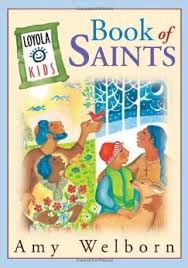
The Loyola Kids' Book of Saints

 Over 40 saints' lives,written at a middle-school reading level.

I. Saints are People Who Love Children St. Nicholas,St. John Bosco, St. Elizabeth Ann Seton, Blessed Gianna Beretta Molla
  Saints Are People Who Love Their Families St. Monica,St. Cyril and St. Methodius, St. Therese of Lisieux,Blessed Frederic Ozanam,

Saints Are People Who Surprise OthersSt. Simeon Stylites,St. Celestine V,St. Joan of Arc,St. Catherine of Siena

Saints Are People Who Create St. Hildegard of Bingen,Blessed Fra Angelico,St. John of the Cross,Blessed Miguel Pro

Saints Are People Who Teach Us New Ways to Pray St. Benedict,St. Dominic de Guzman,St. Teresa of Avila,St. Louis de Monfort

Saints Are People Who See Beyond the Everyday St. Juan Diego, St. Frances of Rome, St. Bernadette Soubirous, Blessed Padre Pio

Saints Are People Who Travel From Home St. Boniface, St. Peter Claver, St. Francis Xavier, St. Francis Solano, St. Francis Xavier Cabrini

Saints Are People Who Are Strong Leaders St. Helena, St. Leo the Great, St. Wenceslaus, St. John Neumann

Saints Are People Who Tell The Truth St. Polycarp, St. Thomas Becket, St. Thomas More, Blessed Titus Brandsma

Saints Are People Who Help Us Understand God St. Augustine of Hippo, St. Jerome, St. Patrick, St. Thomas Aquinas, St. Edith Stein

Saints Are People Who Change Their Lives for God St. Ambrose, St. Gregory the Great, St. Francis of Assisi, St. Ignatius of Loyola, St. Camillus de Lellis, St. Katharine Drexel

Saints Are People Who Are Brave St. Perpetua and St. Felicity, St. George, St. Margaret Clitherow, St. Isaac Jogues, The Carmelite Nuns of Compiegne, St. Maximilian Kolbe

Saints Are People Who Help the Poor and Sick St. Elizabeth of Hungary, St. Vincent de Paul, St. Martin de Porres, Blessed Joseph de Veuster

Saints Are People Who Help In Ordinary Ways St. Christopher, St. Blaise, St. Anthony of Padua, St. Bernard of Montjoux

Saints Are People Who Come From All Over the World Blessed Kateri Tekakwitha, St. Paul Miki, Blessed Peter To Rot, Blessed Maria Clementine Anuarite Nengapeta

Thursday, August 27

Amy Welborn in Living Faith

    Amy Welborn is a contributor - five devotions per issue -  to the Living Faith daily devotional .


"amy welborn"


Today, August 27:


Of course, we search, and we seek. God created us to do just that. But the journey, it seems, goes astray when it becomes oriented towards chasing answers from God to every question rather than being eager to respond to the questions God has for me, content to answer him with my life and my love.


MORE


, July 31:


I’m no prophet, but isn’t the dynamic Jesus describes here much the same? A prophet—Jeremiah, and the Lord himself—has a perspective gained, not just from experience but from eternal insight that can see far beyond what our own narrow viewpoint reveals. Do we resent this and cling to our own narrowness—or do we humbly and gratefully listen?


MORE


July 6:


An acquaintance of mine was running in a marathon, and I was interested in the finish, so I clicked on the visual feed of racers crossing the line. As I watched, I felt inspired. Not by the big winners, though, the pros obviously in shape and position to grab the glory. No, it was the stragglers, dogged and exhausted, who got my attention. They barely jogged, walked and limped across the finish line. But they weren’t sad about their placement; rather, they were jubilant. They’d accomplished their goals. They had not given up!


MORE


 May 10:


Well, Jesus gives us a “TL;DR” here in case we can’t be bothered—or have forgotten—all that he teaches us in his words and deeds: in case we’ve gotten distracted by issues, arguments or even mystical quests, in case we’ve arrived in a place where we excuse our self-serving views and pursuits with the perennial, “Well, I’m sure what Jesus really meant was…”


MORE


April 23:


I can sometimes allow my understanding of myself, my life and God to stagnate. I assume I get it, that I’ve got the answers for all the good—and bad—questions and challenges. 

But is that really so? Is what I think I know now all there is to know? Might I be more open to the Philip I might meet along the way, ready, as the Ethiopian, to have my eyes opened to something new?


MORE


April 4:

Have you ever hit rock bottom? Have you ever been in a situation of such sadness and darkness that you could not imagine ever—I mean ever—feeling anything close to joy again? That there was simply no way to loosen the chains, to not feel the weight of grief, frustration or helplessness that afflicted you at that moment?

And have you ever made it through? Have you found that with time and grace, light glimmers and the weight that seemed to define your days has lightened?

That glimpse? Take that and blow it up, expand it to eternity and let it surround and then sweep away all the heavy darkness of your entire life—of the world.


MORE


March 23:


To imaginatively place ourselves in a Gospel scene is an ancient spiritual practice. To do so here invites us to first see ourselves in a special place: alone with Jesus.

Now he asks: Who has condemned us?

MORE


March 8:


Once again, Jesus’ disciples seem to be almost clueless. They’re also intimidated: They don’t dare ask Jesus why he’s talking to this woman. Here, they can’t see past the literal meaning of his words about food. This dynamic can be both a concern and a comfort to me.

If the disciples spent day and night with Jesus and still didn’t grasp his meaning or purpose, what hope do I have? On the other hand, if even the disciples were confused, I suppose I shouldn’t feel badly when I am either.


MORE


, February 26:


There are so many ways that the Lord gives us strength. It can come as we open ourselves to his grace and just find ourselves stronger in mind, spirit and body. He can bless us with wisdom that gives us perspective and, therefore, strength.

And, of course, God answers our call and strengthens us through others who share our joys and pain, who laugh and cry with us. They are brothers and sisters with whom we can stay strong and even joyful during the journey serving God’s people.

MORE


February 2:


What a richly layered feast this is. It’s the real and final end of the Christmas season: Until a few years ago, the Christmas tree in St. Peter’s Square stayed up until this feast. It’s a day to remember and celebrate religious women and men. And over the centuries, the tradition has grown of bringing candles from home to church to be blessed on this day. Candles that, before electricity, would have been used throughout the year, not just for a decorative touch but to give light necessary for everyday living. The candles, then blessed, would shed not only natural light, but be a sign of Christ’s presence.

MORE


December 28:


Among all the genres of viral videos out there, one that I find most affecting is one I’d call “Children meeting their newborn siblings for the first time.”

From teens to toddlers, those moments are nothing but joy. Even small children break into happy tears when their tiny swaddled-up brother or sister is gently placed in their arms. What a mysterious, profound bond is family love!


MORE


November 19:


Could it be that part of Jesus’ “love language” is to gently and persistently remind me to never rest comfortably in my own worldview? That God always has more to reveal to me, and that I always have more to learn?


MORE


November 2:


In many of these shrines, small and large, there’s another image too. It’s a photograph. An old woman. A child. A young man in a uniform. A candle flickers nearby.

Don’t forget, they say. You walk by and ask for prayers. Don’t forget to pray for us too.


MORE


 October 11:


A friend is going through a terrible, world-shifting time. Life today looks completely different than it did even six months ago. She’s done what she could, but she really can’t do any more. It’s hard and sad. We do what we can to accompany those in difficult places. But it’s a challenge to offer words that don’t end up sounding like empty platitudes, isn’t it? Or even, if we’re going through our own hard times, reading words like the psalmist’s and believing them.


MORE


, June 6:


A few years ago, I wandered into a little church in Ferrara, Italy, and saw a black and white photo of a woman religious in front of a tomb. This Sr. Veronica of the Blessed Sacrament was a Carmelite mystic who had died in 1964. Her canonization cause (in Italian) is: SuorVeronica.org.

I was struck, first, by the notion of running into a new-to-me saint around the corner. What surprising people and stories might I encounter anywhere if I’m paying attention?


Wednesday, August 26

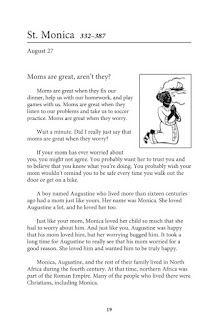
St. Monica - August 27

      St. Monica is in The Loyola Kid's Book of Saints by Amy Welborn  under "Saints are people who love their families."  A page:

"amy welborn"


"amy welborn"

We may not all be mothers, as Monica was, but we all have had one. Our relationships with our mothers might be terrible or beautiful, or somewhere in an in-between place: bewildering, regretful and hopeful.
Desire lies at the heart of our mistakes and successes as parents, caretakers and children. Monica desired her son Augustine's salvation, and Augustine yearned for a love that would not die. Around and around they went.
What is it I desire for others? Is it that, above all, they find authentic, lasting joy?Lord, may I be a help to others as we journey to you.

Tuesday, August 25

Catholic Homeschool Resource on Rosary


Looking for a resources for school or home on Catholic signs and symbols? 

Here is the entry on the Rosary from the Loyola Kids Book of Catholic Signs and Symbols by Amy Welborn. 

 Remember the format: Left-side page has an illustration and a simple explanation for younger children. Right-side page has a more in-depth explanation for older students. This entry is in the section entitled, "At Home."


For centuries people learned about the Christian faith through paintings, sculptures, objects, and gestures. Simple images still convey deep messages if we learn how to see and understand them. Award-winning children’s author Amy Welborn has created a friendly and fascinating sourcebook on the signs and symbols of the Catholic faith. The exquisite illustrations throughout will inspire conversation and prayerful reflection for readers of all ages. Each image appears with a brief, child-friendly explanation coupled with a more detailed description on the opposite page.

From the sign of the fish to the Stations of the Cross, from the palm branch to Our Lady of Guadalupe,
Loyola Kids Book of Catholic Signs and Symbols will enable children and adults to experience faith with curiosity and wonder.


"amy welborn"

"amy welborn"


Monday, August 24

Old Testament Stories for Catholic Children


"amy welborn"

Solomon answered: “You have shown great kindness to your servant, David my father, because he walked before you with fidelity, justice, and an upright heart; and you have continued this great kindness toward him today, giving him a son to sit upon his throne.

Now, LORD, my God, you have made me, your servant, king to succeed David my father; but I am a mere youth, not knowing at all how to act—
8ou have chosen, a people so vast that it cannot be numbered or counted.

Give your servant, therefore, a listening heart to judge your people and to distinguish between good and evil. For who is able to give judgment for this vast people of yours?”


Written by popular Catholic children’s author Amy Welborn, The Loyola Kids Book of Bibles Stories, a  beautifully illustrated collection of Bible stories for kids and their families is uniquely arranged according to where the stories fall in the liturgical year and when they are proclaimed at Mass. Divided into five sections—Advent, Christmas, Lent, Easter Season, and Ordinary Time—each section is subdivided into Old and New Testament stories. From “the Fall” to St. Paul, from the Exodus of the Israelites to the Ascension of Jesus, Loyola Kids Book of Bible Stories nurtures family and individual reading of the Bible at home, while familiarity with these stories will help children connect far more meaningfully with the liturgy.


Sunday, August 23

Catholic Homeschool Resources on the saints

   The Loyola Kids Book of Saints by Amy Welborn contains stories about holy men and women for children, retold in a way to help the reader understand how the saints' journey and struggles might be similar to their own. 


"amy welborn"

From the old Catholic Encyclopedia: 

St. Monica was buried at Ostia, and at first seems to have been almost forgotten, though her body was removed during the sixth century to a hidden crypt in the church of St. Aureus. About the thirteenth century, however, the cult of St. Monica began to spread and a feast in her honour was kept on 4 May. In 1430 Martin V ordered the relics to be brought to Rome. Many miracles occurred on the way, and the cultus of St. Monica was definitely established. Later the Archbishop of Rouen, Cardinal d'Estouteville, built a church at Rome in honour of St. Augustine and deposited the relics of St. Monica in a chapel to the left of the high altar. The Office of St. Monica however does not seem to have found a place in the Roman Breviary before the sixteenth century.v


"amy welborn"


Saturday, August 22

Queenship of Mary - August 22


Here’s Mary and the Christian Life by Amy Welborn. 

"amy welborn"

 And for even more substance from a homily B16 gave in 2005 on the feast – it was also the 40th anniversary of the closing of the Second Vatican Council.  It’s lengthy but SO worth it, an excellent reflection of what he has written elsewhere on it (for example, in this book):

But now we must ask ourselves:  What does “Mary, the Immaculate” mean? Does this title have something to tell us? Today, the liturgy illuminates the content of these words for us in two great images.

First of all comes the marvellous narrative of the annunciation of the Messiah’s coming to Mary, the Virgin of Nazareth. The Angel’s greeting is interwoven with threads from the Old Testament, especially from the Prophet Zephaniah. He shows that Mary, the humble provincial woman who comes from a priestly race and bears within her the great priestly patrimony of Israel, is “the holy remnant” of Israel to which the prophets referred in all the periods of trial and darkness.

In her is present the true Zion, the pure, living dwelling-place of God. In her the Lord dwells, in her he finds the place of his repose. She is the living house of God, who does not dwell in buildings of stone but in the heart of living man. She is the shoot which sprouts from the stump of David in the dark winter night of history. In her, the words of the Psalm are fulfilled:  “The earth has yielded its fruits” (Ps 67: 7).

She is the offshoot from which grew the tree of redemption and of the redeemed. God has not failed, as it might have seemed formerly at the beginning of history with Adam and Eve or during the period of the Babylonian Exile, and as it seemed anew in Mary’s time when Israel had become a people with no importance in an occupied region and with very few recognizable signs of its holiness.

God did not fail. In the humility of the house in Nazareth lived holy Israel, the pure remnant. God saved and saves his people. From the felled tree trunk Israel’s history shone out anew, becoming a living force that guides and pervades the world.

Mary is holy Israel:  she says “yes” to the Lord, she puts herself totally at his disposal and thus becomes the living temple of God.

……..

This is something we should indeed learn on the day of the Immaculate Conception:  the person who abandons himself totally in God’s hands does not become God’s puppet, a boring “yes man”; he does not lose his freedom. Only the person who entrusts himself totally to God finds true freedom, the great, creative immensity of the freedom of good.

The person who turns to God does not become smaller but greater, for through God and with God he becomes great, he becomes divine, he becomes truly himself. The person who puts himself in God’s hands does not distance himself from others, withdrawing into his private salvation; on the contrary, it is only then that his heart truly awakens and he becomes a sensitive, hence, benevolent and open person.

The closer a person is to God, the closer he is to people. We see this in Mary. The fact that she is totally with God is the reason why she is so close to human beings.

For this reason she can be the Mother of every consolation and every help, a Mother whom anyone can dare to address in any kind of need in weakness and in sin, for she has understanding for everything and is for everyone the open power of creative goodness.

In her, God has impressed his own image, the image of the One who follows the lost sheep even up into the mountains and among the briars and thornbushes of the sins of this world, letting himself be spiked by the crown of thorns of these sins in order to take the sheep on his shoulders and bring it home.

As a merciful Mother, Mary is the anticipated figure and everlasting portrait of the Son. Thus, we see that the image of the Sorrowful Virgin, of the Mother who shares her suffering and her love, is also a true image of the Immaculate Conception. Her heart was enlarged by being and feeling together with God. In her, God’s goodness came very close to us.

Thursday, August 20

Fiat Girls

 Ascension Press has announced their new series Fiat Girls. The best way to describe it is: American Girl But Now with Saints!

That is, telling stories in an historical fiction format from the girlhoods of Saints Thérèse of Lisieux, Rose of Lima, and Teresa of Calcutta.

"fiat girls"

My part? An appendix in each book offering insight into the saint’s biography and historical context of each story.

The first three books in the series will be published this fall, but are available for preorder now.


The Fiat Girls™ series brings young readers ages 7 to 11 into relatable stories of female saints, who once were little girls, too. Join them in navigating topics like friendship, the meaning of beauty, and how to lead with love.

Wednesday, August 19

Amy Welborn's Blog

 Amy Welborn blogs at Charlotte Was Both every day - usually at least twice. 

She writes on a variety of topics, including faith, culture, politics, film, books and more. 

"joseph dubruiel"


The blog is here. 

A recent entry:

A few weeks ago, I was a part of a conversation with some local Catholic fellows, all maybe a bit older than I – early to mid-70’s.  The challenge of understanding one of our local non-native English speaking priests came up and one of the men said something like,

“It’s fine – I mean when I was growing up, the whole Mass was in a language we didn’t understand!” And he and the others went on – not in a Twitter-post kind of rabid way, just remembering – what it had been like for them to, in their own recollections, to go to Mass in Latin,  to see their parents and grandparents absorbed in their own rosaries during Mass, and what a obviously welcome  change it was to attend Mass in the vernacular.

They continued, mentioning the existence of those who disagree, and the tone was -as I’ve experienced many times before in this type of conversation with this age group – just baffled about why anyone would want to worship that way, the way they were so relieved to put behind them.  Again, these are super nice guys, so the tone wasn’t judgmental or contemptuous – just perplexed. Mystified, even.

Someone mentioned the TLM parish in town (there are two in the diocese, the other in Huntsville.)  Now, this parish is on the other side of the city , but it’s not at all small, lots of folks go there, and the church building is one of the most beautiful and historic (Deco Romanesque style) in the diocese, but nonetheless, I was surprised how vague their awareness of it was – to the extent they weren’t really sure of its name.

Once again, you never know what you’ll find outside of your bubble. And I’m not talking about their bubble – I’m talking about the bubble in which this issue is, well, the Main Character, 24/7.

Not saying that’s a bad stance to take. Life on earth is made of a zillion pieces, and each of those pieces is the particular interest, obsession and expertise of someone and even if I don’t know a thing about it, it matters and even makes the world go round.

But all the same, it’s so important for anyone with a particular cause or interest to nurture a sense of perspective, an awareness of how your cause is perceived, how it fits into the big picture, and how others who disagree with your perspective think and why.

That is, to get accustomed to steelmanning rather than strawmanning.

Now, you know me. There’s going to be another side, isn’t there?

A Gen Z Catholic of my acquaintance attended, for two weeks in a row, two different Catholic parishes devoted to the Suburban Rite. You can probably imagine: Mostly older crowd, no males in the sanctuary except for the priest, no ceremonial to speak of, a casual presiding style, including some ad-libbing even outside of the times when “these or other words” are permitted to the point where, with one of the Masses, he wondered if it were valid, lots of friendly banter and meaningful gestures meant to communicate warmth and welcoming, including the very emphatic “sisters and brothers” throughout, and of course, music that’s either stuck in around 1989 or a wan rendition of the latest Catholic Praise and Worship repertoire.

He, too, was mystified. 


Tuesday, August 18

Should you homeschool your kids?

  From Amy Welborn

Well, should you?

I’m way past that point, of course, but I thought, since it’s the season, it might be a good time to re-share some posts I wrote nine years ago about homeschooling. As is always the case, many are struggling with schooling decisions, and as time goes on it and the culture shifts, it doesn’t seem to be getting any easier, the decision, that is.

The TL:DR of my posts is: The first set of my kids went to regular school – both Catholic and public (high school for two of them – IB programs). By the time the second set came around, the landscape had changed – both the school landscape and the homeschooling landscape. In short, the school landscape, even in Catholic schools, was getting worse, but the homeschooling landscape was become far more doable, with the advent of the Internet.

Interesting, I think, that the advent of computers and the internet definitely made institutional schooling worse (a hill I will die on) but was integral in the growth of homeschooling, both in terms of ease of access to resources and educational opportunities, and community-building.

Well, this isn’t very TL:DR is it? I’ll try again.

As we entered the 2010’s, my dissatisfaction with the education my kids were receiving in their well-intentioned, competent school grew – and theirs was, too. The cost-benefit ration was way off. Finally, my own conscience started to bother me. I was perfectly capable of teaching these guys up to a certain point and facilitating their, er, educational journeys after that. I had the time. I had the financial resources to do things like travel. It became almost a moral imperative. A conscience-scratcher, for sure.

And how did it turn out? Fine. And varied, as most homeschool, er, journeys go. The older one was in sixth grade when we began. He homeschooled 6th and 7th, and then went to the local Dominican-run school for 8th (they had had issues before, which a parent of one of his friends assured me had been fixed, and they were.) – and then the local Catholic high school for, well, high school. The youngest was in second grade when we began. He homeschooled most of the rest of the time, with a couple of years in the Dominican school, then did high school at home, finished in three years and went off to college, which he will finish up this coming year.

Zero regrets on my part – and I think they’d say the same. One went to school for high school, the other studied at home, mostly self-directed, with a bit of tutoring and a lot of music study – and I think both would say it was the right thing.

So here are the posts I wrote back in 2016 about all of this. They’re available via the tab above, but here you go.


Monday, August 17

Free Catholic E-book

       Here. Now. A Catholic Guide to the Good Life - free today

 So many questions. So many "answers."

Who am I? What do I want out of life? When did everything get so complicated? Where will I find true happiness? Why do I think that’s even possible? How do I choose what’s right and what’s best in a world with a million different voices trying to get me to listen to – and live by – their answers?

There’s a voice that will always tell you the truth. The voice that belongs to the One who created you. The voice that belongs to the One who loves you the most deeply and who wants nothing but the absolute best for you. The voice that belongs to the One who knows where your personal path to true peace and happiness lies.

Originally published in 2004 by Our Sunday Visitor, this ebook version is published by the author, Amy Welboron


"amy welborn"

Friday, August 14

August 14 - St. Maximilian Kolbe

      St. Maximilian Kolbe is included in my Loyola Kids Book of Saints, pp. 244-247 in the section “Saints are people who are brave.”


Over 40 saints’ lives,written at a middle-school reading level.
I. Saints are People Who Love Children
St. Nicholas,St. John Bosco, St. Elizabeth Ann Seton, Blessed Gianna Beretta Molla
amy welbornSaints Are People Who Love Their Families
St. Monica,St. Cyril and St. Methodius, St. Therese of Lisieux,Blessed Frederic Ozanam,
Saints Are People Who Surprise OthersSt. Simeon Stylites,St. Celestine V,St. Joan of Arc,St. Catherine of Siena
Saints Are People Who Create
St. Hildegard of Bingen,Blessed Fra Angelico,St. John of the Cross,Blessed Miguel Pro
Saints Are People Who Teach Us New Ways to Pray
St. Benedict,St. Dominic de Guzman,St. Teresa of Avila,St. Louis de Monfort
Saints Are People Who See Beyond the Everyday
St. Juan Diego, St. Frances of Rome, St. Bernadette Soubirous, Blessed Padre Pio
Saints Are People Who Travel From Home
St. Boniface, St. Peter Claver, St. Francis Xavier, St. Francis Solano, St. Francis Xavier Cabrini
Saints Are People Who Are Strong Leaders
St. Helena, St. Leo the Great, St. Wenceslaus, St. John Neumann
Saints Are People Who Tell The Truth
St. Polycarp, St. Thomas Becket, St. Thomas More, Blessed Titus Brandsma
Saints Are People Who Help Us Understand God
St. Augustine of Hippo, St. Jerome, St. Patrick, St. Thomas Aquinas, St. Edith Stein
Saints Are People Who Change Their Lives for God
St. Ambrose, St. Gregory the Great, St. Francis of Assisi, St. Ignatius of Loyola, St. Camillus de Lellis, St. Katharine Drexel
Saints Are People Who Are Brave
St. Perpetua and St. Felicity, St. George, St. Margaret Clitherow, St. Isaac Jogues, The Carmelite Nuns of Compiegne, St. Maximilian Kolbe
Saints Are People Who Help the Poor and Sick
St. Elizabeth of Hungary, St. Vincent de Paul, St. Martin de Porres, Blessed Joseph de Veuster
Saints Are People Who Help In Ordinary Ways
St. Christopher, St. Blaise, St. Anthony of Padua, St. Bernard of Montjoux
Saints Are People Who Come From All Over the World
Blessed Kateri Tekakwitha, St. Paul Miki, Blessed Peter To Rot, Blessed Maria Clementine Anuarite Nengapeta

Thursday, August 13

Fulton Sheen to be Beatified - September 24, 2026


  Fulton Sheen will be beatified on September 24, 2026. 

Several years ago, Michael Dubruiel edited a prayer book centered on Fulton Sheen's writings.  It is out of print, but there are a few used copies available at reasonable prices here:


From Praying in the Presence of the Lord with Fulton Sheen by Michael Dubruiel


Bishop Sheen’s “Now-moment” corresponds to the thinking of the great spiritual writer Jean Pierre de Caussade. In Abandonment to Divine Providence, Fr. Caussade gives the reader a sure way of knowing the will of God at any moment—by simply confronting the present moment with all its reality. It seems simple, but if we reflect for a second most of us will find that we spend most of our lives avoiding the present moment.


A few years ago an English translation of the Father Caussade’s work appeared in the United States changing the original title to read “The Sacrament of the Present Moment.” This captures the essence of Father Caussade’s work and Bishop Sheen’s meditation that in the present time we are presented with an opportunity that is truly unique. Each moment is sacramental.


Most of us are capable of presenting ourselves with some amount of reflection as we celebrate the sacraments. If we celebrated the sacrament of Baptism as an adult certainly we came expecting to be changed by God. Each time we enter a confessional surely we have examined our conscience beforehand and are penitent expecting to be forgiven by God. Undoubtedly every time we approach the altar to receive the Eucharist we expect to encounter God. But what about the other moments of our lives?


As we awake in the morning, is our first thought of God? As we greet our brothers and sisters throughout the day do we expect that God might be present? Every moment of our lives is an opportunity to encounter God who is always present.


Spend some time reflecting on the following:


1. Go over the events of the present day and ask yourself where God might have been in each of them. Is there a consistent pattern to your day?


2. Reflect on the life of your favorite saint, and meditate on how he or she dealt with the people they met in their daily journeys. How could you imitate this saint? What enabled the saint to act in the way he or she did toward others?


3. Imagine as you leave from this time of prayer that God wishes to continue to be present to you as you go forth. How will you react to his presence in others?


Prayer: Lord, help me to search for you in the garden of life in the same way that St. Mary Magdalene did when she found your tomb empty. May my search be rewarded as hers was by knowledge of your abiding presence. Amen.
"michael dubruiel" "fulton sheen"

Wednesday, August 12

Homeschool High School Religion Resources


Prove It; Prayer


These are the answers teenagers desperately want!

Why didn't God answer my prayers? What's the best way to pray? Does praying do any good at all?

For many teenagers, the whole subject of prayer is a mystery. Amy Welborn helps them understand what the Church teaches, and why what the Church teaches is correct and life-giving. 


Section 1 I Don’t Pray Because….

  1. …God’s In My Heart All the Time
  2. …God Already Knows Everything I Feel: I Don’t Have to Tell Him
  3. …God’s In Control: My Prayer Doesn’t Influence Him
Section II I Want to Pray, But It’s Difficult Because…
  1. …I’m Too Busy
  2. …I Don’t Know Where to Start
  3. …Meditation is Weird
  4. …I Can’t Concentrate
  5. …The Bible is Too Hard to Read
  6. …Memorized Prayers Are Meaningless
  7. …I don’t Know Whether It’s God I’m Hearing, or Just Me
Epilogue: Prayer and the Rest of Your Life

Excerpt from Prove It: Prayer by Amy Welborn

A resource for Catholic youth ministry and Catholic catechesis of youth. 

"amy welborn"


Tuesday, August 11

Amy Welborn Book Review

  Amy Welborn on the mid-century novel The Feast by Margaret Kennedy:


"amy welborn"


The germ of The Feast lies in a conversation Kennedy had in 1937 with writer friends. The group played with the notion of writing a collection, each focusing on one of the seven deadly sins. That specific project never moved beyond the stage of an idea, but Kennedy continued to mull it over until in those post-war years, she found her angle. The Feast is an illustrative sketch of postwar England, a clever theological puzzle, and a suggestive invitation in its own right.


It’s an invitation to the reader to imagine the collection of characters squabbling under the looming cliff, imagine their virtues and vices, and then consider her place there. For in a sense, we are all dwelling under a sort of cliff, one that is bound to collapse at some unknown, surprising moment. We are all invited, as well—invited to the life-saving and life-giving feast hosted by the One the world holds in the least regard. Do we accept? Or do we remain in the inn, as one character thinks as she makes her way up the cliffside to the feast—All alone. All shut up alone in their rooms, yet none of them at peace.

Monday, August 10

St. Lawrence - August 10

    A short interesting article on the iconography of St. Lawrence:


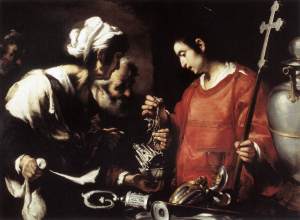
lawrenceAngelico.distributesTreasure


St. Lawrence by Strozzi


The earliest portrait of the saint that I have actually seen is a 5th-century fresco that portrays him as a youthful man, tonsured and wearing the dalmatic of a deacon. The youth, the tonsure, and the dalmatic will stay with him through sixteen more centuries of religious art, with only a few exceptions (example without a dalmatic, example with lush hair). Sometimes the saint will also be pictured with a maniple, a length of cloth that was worn over the left forearm by deacons and priests at Mass, as in the first picture at right. In one case that I have seen, the artist managed to sneak in a bit of the "stole," another vestment that deacons wear at Mass underneath the dalmatic.3
The fresco painter apparently did not include a gridiron. Some of the plaster has fallen away at the bottom, so we cannot be sure. But by the 6th century, the saint is strongly associated with the gridiron, as in the first image at left. In the ensuing centuries, it is by far his most common attribute (example). In most portraits it is shown in a diminutive size as a mere attribute, and in one painting it is reduced to just a grid pattern on the dais beneath Lawrence's throne.
In the Golden Legend the executioners also apply red-hot pitchforks to Lawrence's body, so this becomes another attribute, sometimes used instead of the gridiron (second picture at right).
Another attribute is based on two of the miracles ascribed to St. Lawrence. One involved a heavy golden chalice that the emperor Henry II had given to the Church of St. Lawrence in Eichstätt. When Henry died and his misdeeds were piled up on one side of the scale, the devils hoped to gain his soul. But then St. Lawrence put the chalice on the other side, and Henry was safe. In anger, one of the devils broke off a piece of the chalice, which he referred to as a bowl. In the other miracle a deacon in St. Lawrence's church in Milan dropped a crystal chalice. It broke into pieces, but upon the deacon's prayers St. Lawrence reasssembled it as good as new. Owing to these legends, in some images the saint holds a chalice-like bowl, sometimes with a broken-off piece, as in the third image on the right. Another influence on the chalice attribute is Augustine's remark that St. Lawrence served the church in Rome and "it was there that he administered the sacred chalice of Christ's blood; there that he shed his own blood for the name of Christ."


-Amy Welborn 


Sunday, August 9

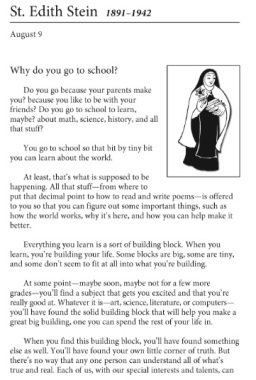
Edith Stein - August 9

      amy-welborn2edith-stein


Today: St. Teresa Benedicta of the Cross - Edith Stein. 

She's in the Loyola Kids Book of Saints by Amy Welborn


 Over 40 saints' lives,written at a middle-school reading level.

  I. Saints are People Who Love Children St. Nicholas,St. John Bosco, St. Elizabeth Ann Seton, Blessed Gianna Beretta Molla

Saints Are People Who Love Their Families St. Monica,St. Cyril and St. Methodius, St. Therese of Lisieux,Blessed Frederic Ozanam,

 Saints Are People Who Surprise OthersSt. Simeon Stylites,St. Celestine V,St. Joan of Arc,St. Catherine of Siena

  Saints Are People Who Create St. Hildegard of Bingen,Blessed Fra Angelico,St. John of the Cross,Blessed Miguel Pro

  Saints Are People Who Teach Us New Ways to Pray St. Benedict,St. Dominic de Guzman,St. Teresa of Avila,St. Louis de Monfort

  Saints Are People Who See Beyond the Everyday St. Juan Diego, St. Frances of Rome, St. Bernadette Soubirous, Blessed Padre Pio

  Saints Are People Who Travel From Home St. Boniface, St. Peter Claver, St. Francis Xavier, St. Francis Solano, St. Francis Xavier Cabrini

  Saints Are People Who Are Strong Leaders St. Helena, St. Leo the Great, St. Wenceslaus, St. John Neumann

  Saints Are People Who Tell The Truth St. Polycarp, St. Thomas Becket, St. Thomas More, Blessed Titus Brandsma

  Saints Are People Who Help Us Understand God St. Augustine of Hippo, St. Jerome, St. Patrick, St. Thomas Aquinas, St. Edith Stein

  Saints Are People Who Change Their Lives for God St. Ambrose, St. Gregory the Great, St. Francis of Assisi, St. Ignatius of Loyola, St. Camillus de Lellis, St. Katharine Drexel

  Saints Are People Who Are Brave St. Perpetua and St. Felicity, St. George, St. Margaret Clitherow, St. Isaac Jogues, The Carmelite Nuns of Compiegne, St. Maximilian Kolbe

  Saints Are People Who Help the Poor and Sick St. Elizabeth of Hungary, St. Vincent de Paul, St. Martin de Porres, Blessed Joseph de Veuster

  Saints Are People Who Help In Ordinary Ways St. Christopher, St. Blaise, St. Anthony of Padua, St. Bernard of Montjoux


  Saints Are People Who Come From All Over the World Blessed Kateri Tekakwitha, St. Paul Miki, Blessed Peter To Rot, Blessed Maria Clementine Anuarite Nengapeta