Tuesday, July 28

Pope Leo for Kids

 Here's a sticker book about Pope Leo. Amy Welborn wrote the text:

The Catholic Church and the world welcomed Pope Leo XIV on May 8, 2025, the first pope born in the USA. Discover interesting facts about his life and priesthood before he became the pope. Plus, learn about the pope’s special role and mission in the Church­—with sticker fun and activities.

Click here to see sample pages.

Free Teaching Guides for Faith-Based Learning

Each guide pairs with a Living Faith Sticker Book and is designed for a 1-hour session—perfect for weekly Religious Education classes or at-home use.

Download your free guides here.


Monday, July 27

Summer Reading for Catholic Kids

     The Loyola Kids Book of Heroes  Amy Welborn


amy welborn


 More saints' lives, organized according to the virtues they expressed through their lives.

I. Faith
  1. Introduction: Jesus is Born
  2. John the Baptist: A Hero Prepares the Way
  3. Early Christian Martyrs: Heroes are Faithful Friends
  4. Medieval Mystery Plays: Heroes Make the Bible Come to Life
  5. St. Albert the Great: Heroes Study God’s Creation
  6. Sister Blandina Segale: Heroes Work in Faith
II. Hope
  1. Introduction: Jesus Teaches
  2. Pentecost: Heroes on Fire with Hope
  3. Paul: A Hero Changes and Finds Hope
  4. St. Patrick and St. Columba: Heroes Bring Hope into Darkness
  5. St. Jane de Chantal: Heroes Hope through Loss
  6. St. Mary Faustina Kowalska: A Hero Finds Hope in Mercy
Charity
  1. Introduction: Jesus Works Miracles
  2. Peter and John: Heroes are Known by their Love
  3. St. Genevieve: A City is Saved by a Hero’s Charity
  4. St. Meinrad and St. Edmund Campion: Heroes love their Enemies
  5. Venerable Pierre Toussaint: A Hero Lives a Life of Charity
  6. Rose Hawthorne Lathrop: A Hero Cares for Those Who Need it Most
  7. Blessed Teresa of Calcutta: A Hero Lives Charity with the Dying
Temperance
  1. Introduction: Jesus Strikes a Balance
  2. Peter and Cornelius: Heroes Love Their Neighbors
  3. Charlemagne and Alcuin: Heroes Use their Talents for Good
  4. St. Francis: A Hero Appreciates Creation
  5. Venerable Matt Talbot: Heroes Can Let Go
  6. Blessed Pier Giorgio Frassati: A Hero Enjoys the Gift of Life
Prudence
  1. Introduction: Jesus Gives Us Leaders to Help us Make Good Choices
  2. Paul and Barnabas at Lystra: Heroes See the Good in All Things
  3. St. Jean de Brebeuf: A Hero Respects Others
  4. Catherine Doherty and Jean Vanier: Heroes Bring New Ideas
  5. Venerable Solanus Casey: A Hero Accepts His Life
  6. Blessed John XXIII: A Hero Finds a New Way

Sunday, July 26

High School Summer Reading


isn't apologetics, but a guide to discipleship. How can a teen live joyfully and faithfully? What does it mean to do that? What's right and what's wrong? What's my life for?
  • Who Am I
  • Sure, I Want to Be a Good Person, But...How?
  • What's Jesus Got To Do With It?
  • It Was Only a Little Lie. So?
  • I've Got All The Time In The World...Don't I?
  • Love Who? Everyone? Really?
  • It's My Body. All Mine.
  • How Far Can I Go?
  • Whose Life Is Worth Living?
  • It's A Big World With Too Many Problems.  Can't I Just Live My Life?
  • "Be Not Afraid"
 
"amy welborn"

Saturday, July 25

Catholic Summer Reading for Teens


Prove It; Prayer

Section 1 I Don’t Pray Because….
  1. …God’s In My Heart All the Time
  2. …God Already Knows Everything I Feel: I Don’t Have to Tell Him
  3. …God’s In Control: My Prayer Doesn’t Influence Him
Section II I Want to Pray, But It’s Difficult Because…
  1. …I’m Too Busy
  2. …I Don’t Know Where to Start
  3. …Meditation is Weird
  4. …I Can’t Concentrate
  5. …The Bible is Too Hard to Read
  6. …Memorized Prayers Are Meaningless
  7. …I don’t Know Whether It’s God I’m Hearing, or Just Me
Epilogue: Prayer and the Rest of Your Life

Excerpt from Prove It: Prayer by Amy Welborn

A resource for Catholic youth ministry and Catholic catechesis of youth. 

"AMy welborn"


Friday, July 24

Catholic Summer Reading for Teens

     This series of apologetics works for Catholic teens and young adults encompasses the diverse questions Catholic teens have in their own hearts about faith, and those they are asked by others.


Prove It: God by Amy Welborn

 I Don't Believe in God Because....

  • ...No One Can Prove He Exists
  • ...Science Shows That the Universe Exists Without a God
  • ...People Could Have Just Made the Stuff in the Bible up
  • ...It’s So Difficult to Find Him
  • ...People Have So Many Different Ideas About Him
  • ...There are So Many Hypocrites in Churches
  • ...People Do Such Horrible Things in the Name of Religion
  • ...It’s What I Believe and I Don’t Need Anyone Else to Tell Me What to Believe!
  • ...I Want to Be Free to Be Myself
  • ...I Don’t Need Him
  • ...Innocent People Suffer


"amy welborn"


Thursday, July 23

Catholic Summer Reading for Teens


Prove It; Prayer

Section 1 I Don’t Pray Because….
  1. …God’s In My Heart All the Time
  2. …God Already Knows Everything I Feel: I Don’t Have to Tell Him
  3. …God’s In Control: My Prayer Doesn’t Influence Him
Section II I Want to Pray, But It’s Difficult Because…
  1. …I’m Too Busy
  2. …I Don’t Know Where to Start
  3. …Meditation is Weird
  4. …I Can’t Concentrate
  5. …The Bible is Too Hard to Read
  6. …Memorized Prayers Are Meaningless
  7. …I don’t Know Whether It’s God I’m Hearing, or Just Me
Epilogue: Prayer and the Rest of Your Life

Excerpt from Prove It: Prayer by Amy Welborn

A resource for Catholic youth ministry and Catholic catechesis of youth. 

"amy welborn"


Wednesday, July 22

St. Mary Magdalene - July 22 - for children


The feastday of St. Mary Magdalene is today, July 22. Here is the entry on her from the Loyola Kids Book of Signs and Symbols by Amy Welborn 


Amy Welborn


For centuries people learned about the Christian faith through paintings, sculptures, objects, and gestures. Simple images still convey deep messages if we learn how to see and understand them. Award-winning children’s author Amy Welborn has created a friendly and fascinating sourcebook on the signs and symbols of the Catholic faith. The exquisite illustrations throughout will inspire conversation and prayerful reflection for readers of all ages. Each image appears with a brief, child-friendly explanation coupled with a more detailed description on the opposite page.
From the sign of the fish to the Stations of the Cross, from the palm branch to Our Lady of Guadalupe, Loyola Kids Book of Catholic Signs and Symbols will enable children and adults to experience faith with curiosity and wonder.​


Tuesday, July 21

The Truth About Mary Magdalene - 4

      From Mary Magdalene: Truth, Legends and Lies by Amy Welborn. 


Chapter 2:


If you were making up the story of the Resurrection from scratch, you would, as a person living in the first century, in the Roman Empire, and presumably as a Jew, only be able to think about this resurrection business in the terms and concepts available to you. And, as N. T. Wright has so ably demonstrated in The Resurrection of the Son of God (Augsburg Fortress Publishers, 2003), even the first-century Jewish world, which did believe in a resurrection of the body, saw it in completely different terms — that it would eventually happen to everyone, at once, at the end of time (Wright, pp. 200-206).
And in general, when you read over the Resurrection accounts in the Gospels, you are immersed in an account in which people are afraid, confused, in awe, and eventually profoundly overjoyed. There is a veil drawn over the core event — the Resurrection itself is never described because, of course, none of the witnesses saw it.
They saw the empty tomb, and they saw the risen Jesus. A clever fabricator and mythmaker would not have woven his account with such nuance, and would probably have offered a direct account of the event itself, perhaps even with a clear explanation of what it all meant. But that’s not what we read, and somehow, ironically, all of the confusion and human frailty is powerful evidence for the truth of the account.
Most importantly for us, a first-century mythmaker would not have featured women as the initial witnesses of these formative events. It is inaccurate to say that first-century Jews did not accept women as reliable witnesses at all. There was, of course, no unified system of law within Judaism, and what was practiced was dependent upon which rabbi’s interpretation of the Law was used. Some rabbis did, indeed, hold the opinion that women were not reliable witnesses, but others disagreed and counted a woman’s witness equal to a man’s.
However, the fact that a woman’s reliability as a witness was disputed, unclear, and not consistently accepted, would, it seems, discourage a fabricator from using women as his source of information that the tomb was indeed empty. It certainly wouldn’t be the first choice to come to mind if your aim was to present a story that was easily credible, would it?
“[And] so that the apostles [the women] did not doubt the angels,Christ himself appeared to them,so that the women are Christ’s apostles and compensate through their obedience for the sin of the first Eve. . . . Eve has become apostle. . . . So that the women did not appear liars but bringers of truth, Christ appeared to the [male] apostles and said to them: It is truly I who appeared to these women and who desired to send them to you as apostles.” (Hippolytus, third century, quoted in Mary Magdalene: Myth and Metaphor, by Susan Haskins [Berkley, 1997], pp. 62-63)


"mary magdalene"

Monday, July 20

The Truth About Mary Magdalene - 3

      From Mary Magdalene: Truth, Legends and Lies by Amy Welborn. 


Chapter 2:
‘WHY ARE YOU WEEPING?’
Luke is the only evangelist to mention Mary Magdalene before the Passion narratives, but once those events are set in motion, Mary is a constant presence in all of the Gospels, without exception. For the first few centuries of Christian life, it is her role in these narratives that inspired the most interest and produced the earliest ways of describing Mary Magdalene: “Myrrh-bearer” and “Equal-to-the-Apostles.”

At the Cross

In both Matthew (27:55) and Mark (15:40-41), Mary Magdalene is named first in the list of women watching Jesus’ execution.
Luke doesn’t name the women at the cross, but he does identify them as those who had “followed him from Galilee.” John also mentions her presence (19:25), but his account highlights the presence of Mary, the mother of Jesus, and Jesus’ words commending her to John’s care.
After Jesus’ body is taken down from the cross, Mary and the other women are still there. Matthew (27:61) and Mark (15:47) both specifically mention her as seeing where Jesus’ body was laid, and Luke again refers to the “women . . . from Galilee” (23:55), whose identity we are expected to understand from Luke’s early mention of their names in chapter 8.
Finally, as the Sabbath passes and the first day of the week dawns, the women still remain, and the Twelve are still nowhere in sight. Matthew describes Mary Magdalene and “the other Mary” (not the mother of Jesus, but probably the Mary, mother of James and Joseph, whom he had mentioned in 27:56) coming to “see” the tomb. Mark and Luke get more specific, saying that the women have come to anoint Jesus’ body. John, interestingly enough, in chapter 20, ignores any other women, and focuses on Mary Magdalene. She comes to see the tomb, finds the stone moved and the tomb empty, and runs to tell Peter.
At least one early critic of Christianity seized on Mary Magdalene’s witness as discrediting. As quoted by the Christian writer Origen,the second-century philosopher Celsus called her a “half-frantic woman” (Contra Celsus, Book II: 59), thereby calling into doubt the truth of her testimony of the empty tomb.
What is striking about John’s account is that even though Peter and others do indeed run to the tomb at Mary’s news and see it empty, that is all they see. They return, and after they have gone away, Mary remains, alone at the tomb, weeping. It is at this point that, finally, the risen Jesus appears.
Of course, Jesus appears to Mary and other women in the Synoptic Gospels as well. In Matthew (chapter 28), an angel first gives them the news that Jesus has risen from the dead. The women then depart to tell the Twelve, and on the way they meet Jesus, they worship him, and he instructs them to tell the disciples to meet him in Galilee.
In Mark (chapter 16), they meet the angel first as well, and receive the same message as Matthew describes, and are, unlike the joy described by Matthew, “afraid.” (Fear and lack of understanding on the part of disciples is a strong theme in Mark’s Gospel, by the way.)
Mark presents us with a bit of a problem, because the oldest full manuscripts of Mark, dating from the fourth century, end at 16:8, with the women afraid, and with no appearance of the risen
Mark presents us with a bit of a problem, because the oldest full manuscripts of Mark, dating from the fourth century, end at 16:8, with the women afraid, and with no appearance of the risen Jesus described. Manuscripts of a century later do contain the rest of the Gospel as we know it, continuing the story, emphasizing Jesus’ appearance to Mary Magdalene, and identifying her as the one from whom he had exorcised seven demons. She sees him, she reports to the others, and they don’t believe it. Jesus then appears to “two of them” (perhaps an allusion to the encounter on the road to Emmaus we read about in Luke 24) who then, again, report the news to the Twelve who, again, do not believe it. Finally, Jesus appears to the disciples when they are at table, and as is normal in the Gospel of Mark, their faithlessness is remarked upon.
Some modern scholars suggest that Mark 16:8 is the “real” ending of this Gospel, which would mean that it contains no Resurrection account. Others, including the Anglican Bishop N. T. Wright, a preeminent scholar of the New Testament, argue that when one looks at Mark as a whole, it is obviously building up to the Resurrection,including prophecies from Jesus himself. Wright theorizes that the original ending was perhaps lost (the ends of scrolls were particularly susceptible to damage), and that what we have now is an attempt by a later editor to patch up that lost ending, but not in a way inconsistent with Mark’s intentions.
The theme of disbelief also runs through Luke. Interestingly enough, this Gospel doesn’t recount an encounter between the women (who are finally again specifically identified) and Jesus, but only the appearance of “two men” in “dazzling apparel,” who remind them of Jesus’ prophecies of his death and resurrection. The women, no longer afraid, go to the apostles, who, of course, dismiss their tale as idle chatter.
What’s clear in these Synoptic Gospels is, first, the strong sense of historical truth about the accounts. Rationalist skeptics would like to dismiss the Resurrection as a fabrication, but if it is, then the storytellers did a terrible job, didn’t they?
After all, if you were creating a myth that would be the origins of your new religion, would you write something in which the central characters — the first leaders of this same religion — were so filled with fear and doubt that they appeared weak?


"mary magdalene"

Sunday, July 19

The Truth About Mary Magdalene - 2

      Mary Magdalene's feast was July 22. Over the next several days, enjoy these excerpts from Amy Welborn's Mary Magdalene: Truth, Legends and Lies. 


Chapter 1:
No, the Gospels are not straight history or biography in the contemporary sense. They are testaments of faith. But they are testaments of faith rooted in what really happened. The evangelists, and by extension, the early Christians, were not about making up stories for which they would later, oddly, give their lives. They were not cleverly presenting their inner psychological transformations in the form of concrete stories. They were witnesses to the amazing action of God in history, through Jesus. 


amy-welborn-book3


They are testimonies of faith, yes, but faith rooted in the realities of God’s movement in the world.
amy-welborn-book2
The evidence seems, at first glance, frustratingly slim: an introduction in Luke, and then Mary’s presence at the cross and at the empty tomb mentioned in all four Gospels. Not much to go on, it seems.
Before the legends, myths, and speculation, and even before the best-selling novels, there was something else: the Gospels.
The figure of Mary Magdalene has inspired a wealth of art, devotion, and charitable works throughout Christian history, but if we want to really understand her, we have to open the Gospels, because all we really know for sure is right there.
But in the context, the situation isn’t as bad as it appears. After all, no one besides Jesus is described in any detail in the Gospels, and even the portrait of Jesus, as evocative as it is, omits details that we moderns are programmed to think are important. Perhaps, given the context, the Gospels tell us more about Mary Magdalene than we think.

Trustworthy?

Before we actually meet the Mary Magdalene of the Gospels, it might be a good idea to remind ourselves of exactly what the Gospels are and how to read them.
The word “Gospel” means, of course, “good news,” or evangel in Greek, which is why we call the writers of the Gospels evangelists. The four Gospels in the New Testament have been accepted as the most authoritative and accurate writings on Jesus’ life since the early second century. Even today, scholars who study early  Christianity, whether they are believers or not, know that when studying Jesus and the early Christian movement, the Gospels and other New Testament writings are the place to begin.
Sometimes in my speaking on this issue, I have fielded questions about the reliability of the Gospels. A questioner will say something like, “Well, they were written so long after the events, how can we trust them to tell the truth?”
In addition, even those of us who have received some sort of religious education might have been taught, implicitly, to be skeptical of the Gospels. We’re reminded, right off, that the Gospels are not history or biography, and that they tell us far more about the community that produced them than about Jesus himself.
In short, all of this gets distilled into the conviction that when it comes to early Christianity, all documents and texts are of equal value in telling us about Jesus. You can’t pick the best according to historical reliability, so you pick the one with the “story” that means the most to you. So, if the Gospel of Mark displeases you, you can go ahead and create your Jesus from what you read in the Gospelof Philip or the Pistis Sophia.
Sorry, but it just doesn’t work that way. As we will see in more detail when we get to the Gnostic writings, there is simply no comparison between the four canonical Gospels and other writ-ings. The canonical Gospels were not written that distant from the events described — forty or fifty years — and were written in an oral culture that took great care to preserve what it heard with care; the community’s history depended on it. When you actually read the Gospels, you see comments here and there from the evangel-ists themselves about what they were trying to do, and part of that involved, according to their own admission, being as accurate as possible (see Luke 1:1-4, for example).
It’s also good to listen to modern Gospel critics carefully. More often than not, those who disdain the Gospels are quick to claim some other text as “gospel,” as the source of truth. Their choice of what to believe usually has far less to do with historical reliability than it does with other factors.
So, no, not all historical texts are equally reliable. When it comes to Jesus and the events of the mid-first century, the canonical Gospels are really the only place to begin.
Now, on to Mary Magdalene.

Magdala

Luke introduces us to Mary Magdalene in chapter 8 of his Gospel:

“Soon afterward he went on through cities and villages, preach-ing and bringing the good news of the kingdom of God. And the twelve were with him, and also some women who had been healed of evil spirits and infirmities: Mary, called Magdalene, from whom seven demons had gone out,and Joanna,the wife of Chuza, Herod’s steward, and Susanna, and many others, who provided for them out of their means.” (Luke 8:1-3)
So here she is: a woman from whom Jesus had driven seven demons, joined with other women, also healed by Jesus, who had left their lives behind to follow him.
Mary is mentioned first in this list, as she is in every list of female disciples, in every Gospel, similar to the way that in lists of the twelve apostles Peter’s name always comes first. The precise reason for Mary’s consistent preeminence is impossible to determine, but we can guess that it might have much to do with her important role related to the Resurrection, as well as to recognition of her faithfulness to Jesus.
These women “provided for them out of their means.” This might mean one of two things, or both: that the women assisted Jesus and his disciples by preparing meals and so on, or that they supported them financially. The second explanation is supported by the presence of Joanna, the wife of a member of Herod’s court, on the list. Perhaps some of these women were, indeed, wealthy enough to give Jesus’ ministry a financial base. (Some legends about Mary have played off of this, as we will see later, suggesting that she was quite wealthy and actually owned the town of Magdala.)
What stands out about Mary is that she’s identified, not by her relationship to a man, as most women would be at that time, but to a town. This indicates that Mary wasn’t married, and perhaps even that she had outlived her father and other male relatives: she was a single woman, able to give support to Jesus out of gratitude for what he had done for her.
Magdala was located on the western shore of the Sea of Galilee, about four miles north of the major city of Tiberias. Today, it is a village with a few hundred inhabitants, some abandoned archaeological digs, and only the most inconspicuous memorials to its most well-known inhabitant.
“Magdala” is derived from the Hebrew Migdal, which means “fortress” or “tower.” It was also called “Tarichea,” which means “salted fish,” a name which reveals the town’s primary industry during the first century, the salting and pickling of fish. Excavations led by Franciscans in the 1970s revealed a structure that some think was a synagogue (others a springhouse), as well as a couple of large villas and, from later centuries, what might be a Byzan-tine monastery. Magdala is described by Josephus, a first-century Jewish historian, as having forty thousand inhabitants, six thou-sand of whom were killed in one of the battles during the Jewish Revolt (A.D. 66-70), but most modern historians believe those numbers are far too high.
Jewish tradition suggests that Magdala was ultimately destroyed as a punishment for prostitution, and another strain holds that in ancient times Job’s daughters died there. Pilgrim accounts from the ninth through the thirteenth centuries report the existence of a church in Magdala, supposedly built in the fourth century by St. Helena, who discovered the True Cross in Jerusalem.
By the seventeenth century, pilgrims reported nothing but ruins at Magdala.

Possessed

Mary — like Peter, Andrew, and the other apostles — walked away from life as she knew it, abandoned everything to follow Jesus. Why?
“. . . from whom seven demons had gone out.”
Exorcism is an aspect of Jesus’ ministry that many of us either forget about or ignore, but the Gospels make clear how important it is: Mark, in fact, describes an exorcism as Jesus’ first mighty deed, in the midst of his preaching (1:25). Some modern com-mentators might declare that what the ancients referred to as pos-session was nothing more than mental illness, but there is really no reason to assume that is true. The “demons,” or unclean or evil spirits, we see mentioned sixty-three times in the Gospels were understood as forces that indeed possessed people, inhabiting them, bringing on what we would describe as mental problems, emotional disturbances, and even physical illness. The symptoms, however, were, to the ancient mind, only that: symptoms. The deeper problem was the alienation from the rest of the human family and from God produced by this mysterious force of evil.
In the world in which Jesus lived, seven was a number that symbolized completion, from the seven days of creation (Genesis 1:1-2:3) to the seven seals on God’s book in Revelation (5:1) and the seven horns and eyes of the Lamb in the same vision (5:6). Mary’s possession by seven demons (also explicitly mentioned in Mark 16:9) indicates to us that her possession was serious and overwhelming — total, in fact. She was wholly in the grip of these evil spirits, and Jesus freed her — totally.
So of course, she left everything and followed him.
It’s worth noting now, even though we’ll discuss it more later, that nowhere in the New Testament is the condition of possession synonymous with sinfulness. The “sinners” in the Gospels — the tax collectors, those who cannot or will not observe the Law, the prostitutes — are clearly distinguished from those possessed. Some Christian thinkers have linked Mary Magdalene to various sinful, unnamed women in the Gospels because of her identification as formerly possessed. There may be reasons, indeed, to link Mary to these women, but possession is not one of them, because the conditions — possession and sinfulness — are not the same thing in the minds of the evangelists.

Disciple

The evangelists used the texts, memories, and oral traditions they had at hand to communicate the Good News about Jesus. Because they were human beings, their writing and editing bears the stamp of their unique concerns and interests. Just as you and a spouse might tell the same story, emphasizing different aspects of it to make different points — perhaps you want to tell the story of your missed flight as a warning about being organized and prepared, and he wants to tell it as a way to highlight the need to go with the flow — the evangelists shaped the fundamental story of Jesus in accord with what struck them as the most significant points of his life and ministry, what their audiences most needed to hear.
In the eighth chapter of his Gospel, Luke has finished introducing Jesus, and is ready to really help his audience understand what being a disciple means. He begins by describing who is following Jesus — the Twelve and the women — and then offers a general description of what Jesus’ ministry is about. Jesus then tells his first parable (the parable of the sower and the seeds, which is the first parable Jesus relates in all of the Gospels), then quickly calms a storm, performs another dramatic exorcism, raises a little girl back to life, and in the midst of it tells his followers, firmly, that his blood relations are not his family, but rather those who “hear the word of God and do it” (Luke 8:21).
So that’s the context of the introduction of Mary Magdalene and the other women — not just to set the stage, to complete the cast of characters, because Luke, like all of the other evangelists, didn’t have vellum to spare to do such a thing. Every word he wrote had a purpose, and it was very focused — here, to set before us, in quick, strong strokes, what this kingdom of God was all about. What do we learn from the presence of the women?
First, we learn that women are present, period. Women were not chattel slaves in first-century Judaism, by any means, but neither were they often, if ever, seen leaving their ordinary lives to follow a rabbi. In fact, scholar Ben Witherington describes this conduct as “scandalous” in the cultural context (Women in the Ministry of Jesus [Cambridge University Press, 1984]):
“We know women were allowed to hear the word of God in the synagogue but they were never disciples of a rabbi unless their husband or master was a rabbi willing to teach them.Though a woman might be taught certain negative precepts of the Law out of necessity,this did not mean they would be taught rabbinic explanations of Torah. For a Jewish woman to leave home and travel with a rabbi was not only unheard of, it was scandalous. Even more scandalous was the fact that women, both respectable and not, were among Jesus’ traveling companions.” (Witherington, p. 117)
And not just any women, either. As we noted earlier, Mary Magdalene was once possessed by seven demons. In this culture, those possessed were ostracized — one man Jesus exorcised is described as living in a cemetery (Luke 8:27). Mary Magdalene, formerly at the margins of society, has been transformed by Jesus and is now welcomed as a disciple. The barriers of class, too, are broken, Luke hints, with the presence of Joanna, the wife of a per-son of stature. In God’s kingdom, Luke makes clear, the world we know is being turned upside down.
Just as every phrase and scene in the Gospels is carefully chosen under the inspiration of the Holy Spirit, so are the parts of the Gospel related. We meet Mary Magdalene here, but we will not see her again for many chapters — until the Passion narrative begins. But when we do encounter her — again, with the other women — here’s what she will be doing: she will be standing near the cross, she will then be preparing Jesus’ body for burial, and later she will see and witness to the empty tomb, and encounter the risen Jesus.
Mary will be serving, still. She serves, watches, and waits, the only remaining link between Jesus’ Galilean ministry, his Passion, and the Resurrection. She is introduced as a grateful, faithful dis-ciple, and that she will remain, a witness to the life Jesus brings.

Already, there’s a sort of mystery: what were these demons? What exactly happened to Mary? The evangelists don’t tell us, perhaps because they and Mary herself knew that life with Jesus is not about looking back into the past, but rather rejoicing in God’s power to transform our lives in the present.

Questions for Reflection

  1. What do we know about Mary Magdalene’s life from the Gospels?
  1. What does her presence in Jesus’ ministry tell you about the kingdom of God that Jesus preached?
  2.   How has God acted in your life with power? How do you respond to that? How would you like to respond?

Saturday, July 18

The truth about Mary Magdalene - 1

     Mary Magdalene's feast is July 22

"amy welborn"


Mary Magdalene: Truth, Legends and Lies by Amy Welborn


was published by Our Sunday Visitor books some years ago, but is now out of print. A digital version is now available through Amazon Kindle. Click on cover for more information:

Are you interested in an objective examination of the life and lore of Mary Magdalene, a narrative that isn't agenda-driven or saturated with ideology?
Do you just want to learn more about Mary Magedalene's identity and role in Christian spirituality, literature and art?

I wrote this book for you.

There's a great deal of material out there on Mary Magdalene, it's true. Some of the scholarly material is really fine, but tooamy welborn many of the books for popular audiences are informed by one ideology or another, or fall completely into fantasy.

In De-coding Mary Magdalene I stick to the facts - what we know about Mary Magdalene from the Gospels, and then how Christian amy welborn tradition in both East and West continued to meditate on the figure of Mary Magdalene, seeing in her the model disciple - and weaving all kinds of fascinating legends around her as well.

Here's the bottom line: The Da Vinci Code propogates the lie that Christianity through the ages marginalized and demonized Mary Magdalene as a "whore" in order to minimize her impact.

Wrong, wrong, wrong.

Mary Magdalene was the second most popular saint of the Middle Ages. And do catch that word - saint - Honoring someone as a saint (feastday July 22) is a truly odd way of "demonizing" a person. Don't you think?

So - come meet Mary Magdalene - as she comes to us in the Gospels, as Christians imagined her through the ages as they contemplated her fidelity and discipleship, and how some contemporary interpreters get her so completely wrong.

Table of Contents

Mary of Magdala
"Why Are You Weeping?
The Real Mary?
Apostle to the Apostles
Which Mary?
The Golden Legend
Touching the Magdalene
To the East
The Penitent
Mary and the Mystics
The Magdalene in Art


Rediscovery

Friday, July 17

The Blessed Carmelite Martyrs of Compiègne


Today is their memorial.

Their story is told in Amy Welborn's Loyola Kids Book of Saints.

amy-welborn

Their story from the website of the Carmelites of Great Britain.

Now, here's something interesting. There have been a couple of filmed versions of this story based in some sense on Bernanos' play (and Le Fort's book). Here's a website comparing them - the 1960 version starring Jeanne Moreau (!) and a more sober 1984 version made for television. Below is a clip of the execution scene and it is quite effective and moving, showing mostly the crowd reactions and transitioning rather slowly to the sisters.

https://www.youtube.com/watch?v=cYq614xqnlI

And then, of course, Poulenc's opera. From First Things last week:

Sister Blanche bolts and hides out alone in the ransacked house of her father, who has just met his nobleman’s end on the guillotine. She resists Mother Marie’s entreaties to come join her sisters in their new gathering place, supposedly a safe one. In fact, it is the last stop before prison, where they are packed into one cell to await their execution. Courage means acknowledging one’s fear and rising above it, and in the final scene, the nuns singing hymns go bravely to their death one by one. The long legato lines of Salve Regina are punctuated but not interrupted by the thuds of the falling blade, until a solitary voice is left to intone the final lines of Veni Creator. Then that voice too is extinguished. The final nun to perish is Sister Blanche, who has arrived at the last minute to realize Sister Constance’s prophetic wish that the two friends die together.

The moral universe of Dialogues is notably opposed to that of the most famous French opera, Georges Bizet’s Carmen (1875)—whether Poulenc explicitly intended the contrast or not. Courage is the great theme of both, but where Poulenc presents the blessed fortitude of nuns willing to die for their faith, Bizet displays the hell-bent daring of characters who risk their lives—and some of whom lose their lives—in the service of the world, the flesh, and the devil: sexual heat, the crowd’s applause, or criminal greed. Here is an operatic world we are more familiar with: perfervid professions of love that are really something less than love, duty and honor and a nobler beloved all abandoned, and the ultimate murder of Carmen, who is as steadfast in her boldness in the face of death as she is volatile in her carnal desires.

Francis Poulenc felt the pull of the profane as well as the sacred, in his work as in his life. He wrote two other operas: Les Mamelles de Tirésias (Tiresias’s Teats, 1947), an opéra-bouffe or farce about the gender-fluid blind seer of Greek mythology, and La Voix Humaine (The Human Voice, 1959), the one-sided phone conversation of a woman cast off by her lover. In performances, the opera often ends with her suicide. Erotic misery was familiar territory to Poulenc, a gay man who was writing Dialogues while watching a lover die of cancer, and fearing he had cancer himself. His sexual temptations had long been a spiritual trial for him, for he was unable to renounce either his desire for men or his devotion to the Catholic Church. Dialogues des Carmélites presents, as eloquently as any modern work of art I know, the courage required to live and die in one’s faith, even though Poulenc knew himself incapable of such heroic will.


Thursday, July 16

Novel by Amy Welborn

  Nothing Else Occurs to Me is a novel by Amy Welborn:


Elizabeth had been feeling like an outsider for a while, even among her friend group.

But when she decided to get involved in church –
really get involved, everything changed.

And changed in ways she could never have predicted, didn’t really understand and couldn’t even talk about.

Except to Michaela, that is. The brainy, bohemian girl who’d just moved from Seattle, who didn’t seem to have time for any of her new classmates, their lives and least of all their church activities, but somehow, when a crisis came, was the only one, Elizabeth sensed, who would understand.


Amy Welborn


Wednesday, July 15

The Ten Commandments for Children

      "amy welborn"


"amy welborn"


For centuries people learned about the Christian faith through paintings, sculptures, objects, and gestures. Simple images still convey deep messages if we learn how to see and understand them. Award-winning children’s author Amy Welborn has created a friendly and fascinating sourcebook on the signs and symbols of the Catholic faith. The exquisite illustrations throughout will inspire conversation and prayerful reflection for readers of all ages. Each image appears with a brief, child-friendly explanation coupled with a more detailed description on the opposite page.
From the sign of the fish to the Stations of the Cross, from the palm branch to Our Lady of Guadalupe, Loyola Kids Book of Catholic Signs and Symbols will enable children and adults to experience faith with curiosity and wonder.​

Tuesday, July 14

July 14 - St. Kateri

     Today is the feast of St. Kateri Tekakwitha. From Pope Benedict's homily at her canonization:


Kateri impresses us by the action of grace in her life in spite of the absence of external help and by the courage of her vocation, so unusual in her culture. In her, faith and culture enrich each other! May her example help us to live where we are, loving Jesus without denying who we are. Saint Kateri, Protectress of Canada and the first native American saint, we entrust to you the renewal of the faith in the first nations and in all of North America! May God bless the first nations!

From the Loyola Kids Book of Saints:

"amy welborn"

"amy welborn"


The Loyola Kids' Book of Saints by Amy Welborn

 Over 40 saints' lives,written at a middle-school reading level.

I. Saints are People Who Love Children St. Nicholas,St. John Bosco, St. Elizabeth Ann Seton, Blessed Gianna Beretta Molla
  Saints Are People Who Love Their Families St. Monica,St. Cyril and St. Methodius, St. Therese of Lisieux,Blessed Frederic Ozanam,

Saints Are People Who Surprise OthersSt. Simeon Stylites,St. Celestine V,St. Joan of Arc,St. Catherine of Siena

Saints Are People Who Create St. Hildegard of Bingen,Blessed Fra Angelico,St. John of the Cross,Blessed Miguel Pro

Saints Are People Who Teach Us New Ways to Pray St. Benedict,St. Dominic de Guzman,St. Teresa of Avila,St. Louis de Monfort

Saints Are People Who See Beyond the Everyday St. Juan Diego, St. Frances of Rome, St. Bernadette Soubirous, Blessed Padre Pio

Saints Are People Who Travel From Home St. Boniface, St. Peter Claver, St. Francis Xavier, St. Francis Solano, St. Francis Xavier Cabrini

Saints Are People Who Are Strong Leaders St. Helena, St. Leo the Great, St. Wenceslaus, St. John Neumann

Saints Are People Who Tell The Truth St. Polycarp, St. Thomas Becket, St. Thomas More, Blessed Titus Brandsma

Saints Are People Who Help Us Understand God St. Augustine of Hippo, St. Jerome, St. Patrick, St. Thomas Aquinas, St. Edith Stein

Saints Are People Who Change Their Lives for God St. Ambrose, St. Gregory the Great, St. Francis of Assisi, St. Ignatius of Loyola, St. Camillus de Lellis, St. Katharine Drexel

Saints Are People Who Are Brave St. Perpetua and St. Felicity, St. George, St. Margaret Clitherow, St. Isaac Jogues, The Carmelite Nuns of Compiegne, St. Maximilian Kolbe

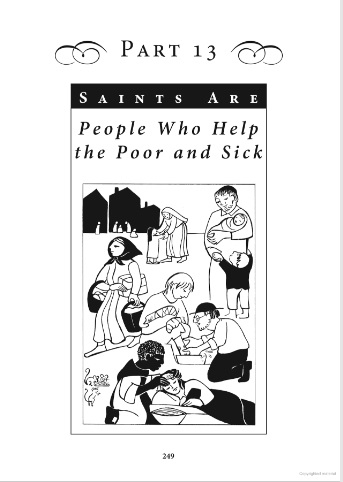
Saints Are People Who Help the Poor and Sick St. Elizabeth of Hungary, St. Vincent de Paul, St. Martin de Porres, Blessed Joseph de Veuster

Saints Are People Who Help In Ordinary Ways St. Christopher, St. Blaise, St. Anthony of Padua, St. Bernard of Montjoux

Saints Are People Who Come From All Over the World Blessed Kateri Tekakwitha, St. Paul Miki, Blessed Peter To Rot, Blessed Maria Clementine Anuarite Nengapeta

Monday, July 13

David and Goliath for Kids


Amy Welborn

The story of David and Goliath from 1 Samuel, retold for children, from Amy Welborn's Loyola Kids Book of Bible Stories:

Written by popular Catholic children's author Amy Welborn, this beautifully illustrated collection of warm and engaging Bible stories for children and their families is arranged in a uniquely Catholic way—based on the liturgical year and the order in which they are proclaimed during Mass. Divided into five sections—Advent, Christmas, Ordinary Time, Lent, and Easter—each section is subdivided into Old and New Testament stories.

From the Creation to St. Paul, the charming illustrations in Loyola Kids Book of Bible Stories and Welborn's friendly writing style turn reading the Bible into an experience that draws families closer together and deeper into the heart of the Church.


Sunday, July 12

Amy Welborn on Prayer

       Scripture Passages that Changed My Life a collection of essays by Living Faith authors - is now available. Amy Welborn has an essay included. From the publisher's description:


The power of Scripture to guide us to a closer relationship with the Lord and one another may be hard to describe. But one of the best ways to learn about his divine power is through the experiences of others.For decades, the authors featured in this book have inspired readers with their reflections on Scripture through the pages of the ever-popular Living Faith Daily Catholic Devotions magazine. Now, get a personal, behind-the-scenes look at which Scripture passages have most inspired them.In Scripture Passages That Changed My Life , ten of Living Faith's most well-known authors each explain how meditating on the word of God has changed their lives. Allow the lessons that they have learned to deepen your prayer experience and maybe even change your life, through the word of God.

amy_welborn

Saturday, July 11

St. Benedict - July 11 by Amy Welborn


Benedict4Today, we celebrate a great, fascinating saint. 
He's in The Loyola Kids Book of Saints by Amy Welborn under "Saints are people who teach us new ways to pray." Here are some excerpts - click on images to get a fuller view.
"amy welborn"

Friday, July 10

Amy Welborn on Online Religion Writing

 Amy Welborn on online religion writing

"amy welborn"

It happens all the time. It is a constant temptation.  In the late 1950’s and early 60’s, faith was diluted in the marketplace most often by sentimentality and idealistic, black-and-white caricatures of virtue. In the present moment—which, given the pace of change, might last until next week—the market demands a kind of performative authenticity played out by personalities, inviting you to faith, not so much because it is objectively real and true, but because, well, I’m a part of it and I’m pretty cool, so you’ll probably want to join up, too.

The format has changed, pamphlets replaced by Instagram posts and sentimental tales supplanted by first-person accounts of self-acceptance, but the dynamic is the same: the risk and fact of the content being shaped by the format, the message by the needs of the messenger and demands of the audience. So evangelization in the age of Instagram becomes just what Instagram and the rest of social media is: an aspirational marketplace trading in curated imperfection and performative authenticity.

Thursday, July 9

Amy Welborn on Willa Cather's Catholic Imagination

From Church Life Journal, Amy Welborn on "The Limits of Willa Cather's Catholic Imagination"

If there is any book in which Cather comes close to this struggle, to this forging, it is in the novella My Mortal Enemy, her last book before she wrote Death Comes for the Archbishop. Here she edges right up to this precipice of confronting the individual’s interior journey from brokenness to a recognition of that brokenness to the possibility of wholeness. It is a painful journey Cather tells, with just a glimmer of hope won from suffering at the end, and the more I think about it, the more Death Comes for the Archbishop, as beautiful as it is, seems like a turn from those dangerous personal waters to the safe distance of history.